Breakthrough Technology Accelerates Solid-State Lighting
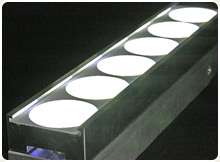
"SPE" method boosts LED development with dramatic increase in light output
Scientists at the Lighting Research Center (LRC) at Rensselaer Polytechnic Institute have developed a method known as "SPE" to get significantly more light from white LEDs (light-emitting diodes) without requiring more energy.
Image: LED fixture incorporating SPE technology
“We have developed a technology based on a new scattered photon extraction (SPE) method that will speed up the progress of solid-state lighting and help secure our nation’s energy future,” said Nadarajah Narendran, Ph.D., director of research at the LRC. “The new technology dramatically increases light output and efficacy of white LEDs, and could play a fundamental role in the evolution of white LEDs for lighting in homes and offices.”
Commercially available white LEDs combine a light-emitting semiconductor with a phosphor, a rare earth compound, to produce visible white light. However, more than half of the light, or photons, produced by the phosphor is diverted back toward the LED where much of it is lost due to absorption. This reduces the LED’s overall light output.
A research group, led by Dr. Narendran, developed a method to extract the backscattered photons by moving the phosphor away from the semiconductor and shaping the LED lens geometry. When combined, these changes allow the photons that would typically be absorbed inside the LED to escape as visible light. The new technology is patent pending.
“Demonstration of this new ‘remote phosphor’ concept by Rensselaer’s Lighting Research Center is an exciting development for solid-state lighting,” said Dr. Jeffrey Tsao, principal member of the technical staff at Sandia National Laboratories. “This advance has a number of significant implications, including higher-efficiency extraction of photons.”
Compared to commercial white LEDs, prototypes of the new SPE LED technology produced 30-60 percent more light output and luminous efficacy—light output (lumens) per watt of electricity. This means more visible light is produced without increasing energy consumption. Further research into the SPE technology could result in even higher levels of light output and greater luminous efficacy, according to Narendran.
The industry has set a target for white LEDs to reach 150 lumens per watt (lm/W) by the year 2012. The new SPE LEDs, under certain operating conditions, are able to achieve more than 80 lm/W, compared to today’s typical compact fluorescent lamp at 60 lm/W and a typical incandescent lamp at 14 lm/W.
“As LED components improve in efficiency, SPE will further multiply those improvements and help catapult the industry toward its goal,” said Narendran. “The possibility of solid-state lighting replacing traditional incandescent and fluorescent lamps looks promising.”
According to Narendran, his group is the first to use the SPE method to improve white LED performance. The research was funded by the U.S. Department of Energy’s Building Technologies Program and the National Energy Technology Laboratory through its competitive research and development program (cooperative agreement no. DE-FC26-01NT41203), and is a collaborative effort with the University of California, Santa Barbara.
The SPE research is published online in the journal physica status solidi (a), published by John Wiley & Sons, and will be published in an upcoming print edition of the journal.
Narendran joined Rensselaer’s Lighting Research Center in 1996 and was named director of research for the LRC in 1998. He is also an associate professor within Rensselaer’s School of Architecture. Narendran earned a doctorate in physics in 1991 and a master’s in physics in 1987 from the University of Rhode Island, and a bachelor’s in physics in 1983 from the University of Peradeniya, Sri Lanka.
LED Technology
LEDs are made of semiconductor chips and emit light when a current passes through them. LED lighting offers many benefits, including safety, flexibility and light quality. Since LED lighting systems have proved to be very effective in applications where brightness, visibility and long-life are important, they were typically used for exit signs and traffic signals, and then applications expanded to include small-area lighting.
Lighting applications that use light-emitting diodes are referred to as solid-state lighting (SSL). According to the U.S. Department of Energy, by 2025, SSL could displace general illumination light sources such as incandescent and fluorescent lamps, decreasing national energy consumption for lighting by 29 percent.
To learn more about the ground-breaking SSL research taking place at the LRC, visit its SSL Web site at www.lrc.rpi.edu/programs/solidstate/
Source: Rensselaer Polytechnic Institute


