First Nano Grows Ultra-Long High Purity Aligned Carbon Nanotubes
Apr 04, 2005
First Nano Grows Ultra-Long High Purity Aligned Carbon Nanotubes

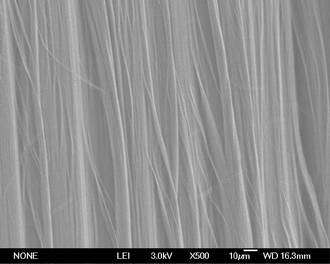
First Nano grows high-density vertically aligned carbon nanotubes over 1 mm long.
First Nano today announced that lab experiments with the EasyTube 2000 System has proven to grow high purity, vertically aligned carbon nanotubes (CNT) over 1 mm long, on silicon substrate using an iron thin film catalyst. The fully automated, high-throughput EasyTube 2000 System is a chemical vapor deposition tool for the synthesis of nanotubes and other nanoscale materials.

"Our system has demonstrated the ability to grow ultra-long and controllable diameter nanotubes,” said Dr. Yi Tu, Principal Research Scientist with First Nano. “The value that these densely formed ultra-long nanoscale strands offers is application development that can be used for composite materials strengthening, rechargeable batteries, filtration systems and electronic devices.”

The process development for growing CNTs is part of a solution package that First Nano offers to customers, and is embedded in preprogrammed recipes in the EasyTube System.

First Nano's website: www.firstnano.com/

Explore further: How nanotechnology could keep your heart healthy

add to favorites email to friend print save as pdf

Related Stories

The longest carbon nanotubes you've ever seen

May 10, 2007

Using techniques that could revolutionize manufacturing for certain materials, researchers have grown carbon nanotubes that are the longest in the world. While still slightly less than 2 centimeters long, ...

Researchers Grow 7 mm Carbon Nanotube Array

Nov 29, 2006

Nanotechnology revolves around the creation of technology — films, materials, devices, applications and systems — on a scale of 1–100 nanometers. But what is a nanometer? A nanometer is one billionth ...

Recommended for you

How nanotechnology could keep your heart healthy

May 17, 2013

Since the heart is such a delicate and critical organ, clinicians usually opt not to intervene with the dead cells that remain after a heart attack or cardiac disease. "But we think that all heart attacks deserve some kind ...

Stacking 2-D materials produces surprising results

May 16, 2013

(Phys.org) —Graphene has dazzled scientists, ever since its discovery more than a decade ago, with its unequalled electronic properties, its strength and its light weight. But one long-sought goal has proved ...

User comments : 0

More news stories

Graphene joins the race to redefine the ampere

A new joint innovation by the National Physical Laboratory (NPL) and the University of Cambridge could pave the way for redefining the ampere in terms of fundamental constants of physics. The world's first ...

Catching graphene butterflies

Writing in Nature, a large international team led Dr Roman Gorbachev from The University of Manchester shows that, when graphene placed on top of insulating boron nitride, or 'white graphene', the electr ...

Morocco to harness the wind in energy hunt

Morocco is ploughing ahead with a programme to boost wind energy production, particularly in the southern Tarfaya region, where Africa's largest wind farm is set to open in 2014.

Galaxy's Ring of Fire

Johnny Cash may have preferred this galaxy's burning ring of fire to the one he sang about falling into in his popular song. The "starburst ring" seen at center in red and yellow hues is not the product of ...