Left-right brain mystery - trail is hot and cold
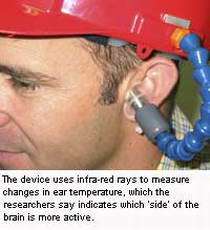
ANU researchers have developed a new device that could potentially unravel the mysteries of the left and right brain by measuring ear temperature.
The device, which may also have medical applications, offers scientists a cost-effective way of testing which side of the brain is active when performing different tasks. Scientists know that, depending on what kind of work the brain is doing, one side is likely to be more active - broadly speaking, language skills, for example, are handled by the left side of the brain and spatial questions are dealt with in the right - but brain scans can be an expensive research tool.
The new device, developed by psychologists Mr Nicolas Cherbuin and Dr Cobie Brinkman, measures the temperature inside a subject’s ears to work out which side of the brain is busier.
“If an area of the brain is more active it needs more blood, which flows up the carotid artery on either side of neck,” Mr Cherbuin said. “This blood is shared between the brain and the inner ear, so by measuring the ear temperature we can work out which side of the brain is more active.
“Because the blood flowing to the brain is cooler than blood already in the brain, a decrease in ear temperature indicates increased blood flow and therefore increased activity on that side of the brain.”
The test, which uses highly sensitive infra red detectors placed in the ear, was developed using two tasks, one that is known to be handled by the left side of the brain (a language task involving rhyming words) and another that scientists know is carried out on the right (which involved mentally constructing three-dimensional cubes after seeing an ‘unfolded’ two-dimensional one).
Minute fluctuations (of less than 0.1 degree) in ear temperature were found to be a highly effective indicator of brain activity.
While magnetic resonance imaging (MRI) machines can cost hundreds of thousands of dollars and scans can cost $1,000 or more per subject, the new ANU device is likely only to involve an upfront cost of roughly $5,000.
The device has potential to help unravel the mysteries of left- and right-brained people; popular theories about which are based largely on untested extrapolation of the idea that one side is holistic while the other is analytical, Mr Cherbuin said.
“Everything points to people often having one side that is more active than the other, but it may not be as clear cut as simply saying someone is left-brained or right-brained,” he added.
Future research applications include working out which side of the brain allocates attention — deciding what to concentrate on from the multitude of stimuli to which we are subjected — and working with stroke victims, who have lost brain function on one side.
The research has been announced to coincide with Brain Awareness Week.
Source: The Australian National University


