Hydrogen and Methane Sustain Unusual Life at Sea Floor's 'Lost City'
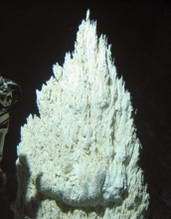
The hydrothermal vents at the ocean bottom were miles from any location scientists could have imagined. One massive seafloor vent was 18 stories tall. All were creamy white and gray, suggesting a very different composition than the hydrothermal vent systems that have been studied since the 1970s.
Scientists who named the spot Lost City knew they were looking at something never seen before when the field was serendipitously discovered in Dec. 2000, during a National Science Foundation (NSF) expedition to the mid-Atlantic.
This week in the journal Science, researchers publish for the first time findings about the gases produced at Lost City and the organisms that live off of them.
Image: The top few feet of an actively venting carbonate chimney. Credit: University of Washington
Both are so different from so-called black-smoker hydrothermal vents they may provide a whole new avenue for studying the earliest life on Earth as well as looking for signs of life on other planets, according to Deborah Kelley, a University of Washington oceanographer and lead author of the report.
“This finding is an exciting example of NSF’s commitment to discovery through basic research,” said Bilal Haq, director of NSF’s marine geology and geophysics program, which funded the research. “Lost City shows us that geological, chemical and biological processes are intimately linked at a primal environment, and lends strong support to the need for interdisciplinary approaches to scientific research.”
The field was named Lost City in part because it sits on a seafloor mountain named the Atlantis Massif, and because researchers were using the Woods Hole Oceanographic Institution's vessel Atlantis when the area was discovered. The field is about 300 feet by 1,000 feet, has 30 large vents, some 30 to 200 feet tall, and contains hundreds of smaller structures. Steep cliffs behind the field are shingled with carbonate.
Microorganisms at Lost City live in highly alkaline fluids that are nearly as caustic as drain opener, Kelley says, whereas organisms inhabiting black-smoker vents are well adjusted to acidic fluids..
Further, she says, Lost City microbes appear to live off bountiful methane and hydrogen. But absent is carbon dioxide, the key energy source for life at black-smoker vents. And there is little hydrogen sulfide and only very low traces of metals, a common staple for many of the microbes at the other kind of vents.
According to researchers, a circulation pattern known as serpentinization creates a chemical reaction between seawater and the mantle rock on which Lost City sits and accounts for the differences in living environments in the two vent areas. The resulting fluids are 105 to 170 . At the other kind of field, first discovered in the early 1970s, volcanic activity or magma drives venting and heats fluids to 700 degrees Fahrenheit. The vents at such sites are often referred to as black smokers because some emit hot, mineral-laden fluid that looks like dark, billowing smoke when it hits the icy cold seawater.
Carbonate minerals from fluids at Lost City drape nearby cliffs in brilliant white and form vents ranging in shape from tiny toadstools to the 18-story column, named Poseidon, which dwarfs most known black smoker vents by at least 100 feet. Some places resemble the sort of deposits one might see in spectacular caves with spires and smoothly rippled surfaces in a complex 3-dimensional array, says Duke University’s Jeffrey Karson, co-author of the paper.
Although no one has yet found another field like Lost City, Kelley says she’s sure others exist, because there are so many other places mantle rock has been thrust up through the seafloor, exposing it to seawater and serpentinization.
Perhaps Lost City can provide additional chemical remnants of organisms to help identify ancient life in those rocks or on other planets. “We don’t, in most places, have access to early Earth conditions, so if we can understand the chemical reactions, sources of energy and how fluids circulate through Lost City, it may give us insight into how life started on this planet,” Kelley says.
Source: NSF


