NASA's Cassini Spacecraft Continues Making New Discoveries
Feb 24, 2005
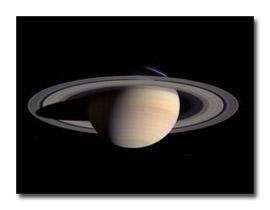
A natural color view of Saturn taken by the Cassini spacecraft on its approach to the planet

NASA's Cassini spacecraft continues making new and exciting discoveries. New findings include wandering and rubble-pile moons; new and clumpy Saturn rings; splintering storms and a dynamic magnetosphere.
"For the last seven months it has been a nonstop, science-packed mission. It has been a whirlwind, and already we have many new results," said Dr. Dennis Matson, Cassini project scientist at NASA's Jet Propulsion Laboratory, Pasadena, Calif.

Weak, linear density waves caused in Saturn's rings by the small moons Atlas and Pan have yielded more reliable calculations of their masses. The masses imply the moons are very porous, perhaps constructed like rubble piles. They are similar to the moons that shepherd Saturn's F ring, Prometheus and Pandora.

Another discovery was a tiny moon, about 5 kilometers (3 miles) across, recently named Polydeuces. Polydeuces is a companion, or "Trojan" moon of Dione. Trojan moons are found near gravitationally stable points ahead or behind a larger moon. Saturn is the only planet known to have moons with companion Trojan moons.

The new findings, published in this week's edition of the journal Science, include refinements in the orbits of several of Saturn's small satellites. One intriguing result is the eccentric and slightly inclined orbit of Pan in Saturn's A ring. The orbit's shape is significant, as it indicates the type of interaction the moon has with the ring material surrounding it. If Pan's orbit remains eccentric due to this interaction, then planets growing in a disc of material surrounding a star may also have eccentric orbits. This may help explain the eccentric paths of planets orbiting other stars.

Several faint Saturn rings have been discovered in Cassini images. Some lie in various gaps in the rings and may indicate the presence of tiny embedded moons acting as shepherds. Several of the rings are kinked, likely evidence of nearby moons.

Scientists also found Saturn's winds change with altitude, and small storms emerge out of large ones. For the first time, Cassini images captured possible evidence of processes that may maintain the winds on Saturn. The observations offer a glimpse into the process which transfers energy by convection from Saturn's interior to help sustain strong winds.

Other results improve the understanding of Saturn's complex magnetic environment. "Saturn's magnetosphere is truly unique. It's dynamically similar to Jupiter's, but in places it chemically resembles water-based plasmas surrounding comets," said Dr. David Young. Young is Cassini principal investigator for the plasma spectrometer instrument from the Southwest Research Institute, San Antonio.

Another surprising find was made by the ion and neutral mass spectrometer instrument, which measured molecular oxygen ions above Saturn's ring plane. "This is at first surprising since the rings are made of water ice," said Dr. Hunter Waite, principal investigator for the spectrometer from the University of Michigan, Ann Arbor. "This may have important consequences for the identification of spectral features to use in the search for life on extrasolar terrestrial planet systems."

The abundance of molecular oxygen on Earth is uniquely tied to biology. But these new measurements at Saturn suggest there are lifeless processes associated with cold icy surfaces that may produce an independent pathway for the formation of molecular oxygen in atmospheres.


Explore further: Slovenian flyer lands in France on return trip from Arctic

add to favorites email to friend print save as pdf

Related Stories

Forecast for Titan: Wild weather could be ahead

2 hours ago

(Phys.org) —Saturn's moon Titan might be in for some wild weather as it heads into its spring and summer, if two new models are correct. Scientists think that as the seasons change in Titan's northern hemisphere, ...

Cassini shapes first global topographic map of Titan

May 15, 2013

(Phys.org) —Scientists have created the first global topographic map of Saturn's moon Titan, giving researchers a valuable tool for learning more about one of the most Earth-like and interesting worlds ...

Saturn's little wavemaking moon

Apr 25, 2013

Captured on January 15, this narrow-angle Cassini image shows an outer portion of Saturn's A ring on the left and the ropy F ring crossing on the right. The thin black line near the A ring's bright edge is ...

Cassini observes meteors colliding with Saturn's rings

Apr 25, 2013

(Phys.org) —NASA's Cassini spacecraft has provided the first direct evidence of small meteoroids breaking into streams of rubble and crashing into Saturn's rings. These observations make Saturn's rings ...

Image: Facing Enceladus

Apr 23, 2013

(Phys.org) —A patchwork network of frozen ridges and troughs cover the face of Enceladus, Saturn's most enigmatic of icy moons.

Recommended for you

Galaxies fed by funnels of fuel

2 hours ago

(Phys.org) —Computer simulations of galaxies growing over billions of years have revealed a likely scenario for how they feed: a cosmic version of swirly straws.

Dark, massive asteroid to fly by Earth on May 31

6 hours ago

It's 1.7 miles long. Its surface is covered in a sticky black substance similar to the gunk at the bottom of a barbecue. If it impacted Earth it would probably result in global extinction. Good thing it is ...

Source of life running out: water scientists

9 hours ago

The majority of people on Earth people will face severe water shortages within a generation or two if pollution and waste continues unabated, scientists warned at a conference in Bonn Friday.

Research team explains 'Lazarus' comets

9 hours ago

Astronomers from the University of Antioquia have discovered a graveyard of comets. These once-dormant comets, dubbed by astronomers as "The Lazarus comets," are now rejuvenated.

User comments : 0

More news stories

Galaxies fed by funnels of fuel

(Phys.org) —Computer simulations of galaxies growing over billions of years have revealed a likely scenario for how they feed: a cosmic version of swirly straws.

Dark, massive asteroid to fly by Earth on May 31

It's 1.7 miles long. Its surface is covered in a sticky black substance similar to the gunk at the bottom of a barbecue. If it impacted Earth it would probably result in global extinction. Good thing it is ...

Source of life running out: water scientists

The majority of people on Earth people will face severe water shortages within a generation or two if pollution and waste continues unabated, scientists warned at a conference in Bonn Friday.

Google eyes emerging markets networks

Google has become deeply involved in a series of projects to build and operate wireless networks in emerging markets including sub-Saharan Africa and Southeast Asia, a report said Friday.

Facial-recognition technology proves its mettle

(Phys.org) —In a study that evaluated some of the latest in automatic facial recognition technology, researchers at Michigan State University were able to quickly identify one of the Boston Marathon bombing ...