Arecibo Begins Search for Dark Galaxies
Feb 08, 2005
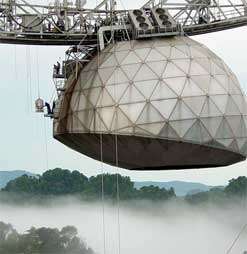
Arecibo  radio telescope

Fitted with a new compound eye, the Arecibo radio telescope in Puerto Rico last week began a multiyear effort to survey all the galaxies in a large swath of sky out to a distance of 800 million light years—a survey that may well uncover the often-theorized, but never-seen, "dark galaxies."

If they do exist, dark galaxies, would be vast clumps of primordial hydrogen and helium gas that have drifted through the universe for 10 billion years or more, but for some reason have never been able to turn that gas into stars. As such, they would account for at least some of the mysterious cosmic "dark matter," which makes itself known only by its gravitational effects on the ordinary, star-rich galaxies. Certainly the dark galaxies would have been missed by previous astronomical surveys, most of which were restricted to optical and infrared light; the cold hydrogen and helium of a dark galaxy would shine only at radio wavelengths—Arecibo's specialty.

Funded by the National Science Foundation and operated by the the National Astronomy and Ionosphere Center at Cornell University, the 305-meter-wide Arecibo Observatory telescope is the world's largest and most-sensitive single-dish radio telescope. Last year, its sensitivity was further boosted by the Arecibo L-Band Feed Array (ALFA): essentially a seven-pixel camera that will allow astronomers to collect data about seven times faster than before. The the survey project starting today has thus been dubbed ALFALFA, for Arecibo Legacy Fast Alfa Survey.

Explore further: Don't pin US tornado on climate change, UN panel head says

add to favorites email to friend print save as pdf

Related Stories

Cosmic dance produces a new galaxy in NGC 3166/9

Jun 20, 2012

A team of astronomers from Queen's University, the Royal Military College of Canada (RMCC) and their world-wide collaborators have detected what is believed to be a "tidal" dwarf galaxy (TDG). Only a handful of bona-fide ...

Listening to the stars

Dec 01, 2011

It is almost night on the island of Puerto Rico. Astronomer Joanna Rankin raises her head toward the sky. A few of the brightest stars shine through blue cracks in a ragged dome of gray clouds. To her back, ...

Scientists search for dark galaxies through the AGES

Apr 05, 2006

First results from the Arecibo Galaxy Environment Survey (AGES) suggest the discovery of a new dark galaxy. The AGES survey, which started in January 2006, is the most sensitive, large-scale survey of neutral hydrogen to ...

New evidence for a Dark Matter Galaxy

Jan 12, 2006

New evidence that VIRGOHI 21, a mysterious cloud of hydrogen in the Virgo Cluster 50 million light-years from the Earth, is a Dark Galaxy, emitting no star light, was presented today at the American Astronomical ...

Seeing the invisible – first dark galaxy discovered?

Feb 23, 2005

A British-led team of astronomers have discovered an object that appears to be an invisible galaxy made almost entirely of dark matter – the first ever detected. A dark galaxy is an area in the universe containing ...

Recommended for you

Power of US tornado dwarfs Hiroshima bomb

40 minutes ago

Wind, humidity and rainfall combined precisely to create Monday's massive killer tornado in Oklahoma. The awesome amount of energy released dwarfed the power of the atomic bomb that leveled Hiroshima.

Climate change and wildfire: Synthesis of recent findings

3 hours ago

Concerns continue to grow about the effects of climate change on fire. Wildfires are expected to increase 50 percent across the United States under a changing climate, over 100 percent in areas of the West by 2050 as projected ...

Moore tornado a rarity, experts say

5 hours ago

Tornados, among the most violent of atmospheric storms, rarely reach the size and brutality of the twister that swept through an Oklahoma City suburb on Monday, experts say.

User comments : 0

More news stories

Power of US tornado dwarfs Hiroshima bomb

Wind, humidity and rainfall combined precisely to create Monday's massive killer tornado in Oklahoma. The awesome amount of energy released dwarfed the power of the atomic bomb that leveled Hiroshima.

Climate change and wildfire: Synthesis of recent findings

Concerns continue to grow about the effects of climate change on fire. Wildfires are expected to increase 50 percent across the United States under a changing climate, over 100 percent in areas of the West by 2050 as projected ...

Amazon plans greenhouse-style headquarters

US online giant Amazon has unveiled plans for a futuristic greenhouse style headquarters "where employees can work and socialize in a more natural, park-like setting."

Biomarkers discovered for inflammatory bowel disease

Using the Department of Defense Serum Repository (DoDSR), University of Cincinnati (UC) researchers have identified a number of biomarkers for inflammatory bowel disease (IBD), which could help with earlier diagnosis and ...