Red Planet Reconnaissance
Every 26 months, the Solar System's planetary dance brings Mars and Earth closer than usual, providing an ideal chance to launch a mission to the Red Planet. In 2001, NASA's Mars Odyssey launched to study its climate. Two years later, twin Mars Exploration Rovers Spirit and Opportunity began a mission that confirmed water once existed on Mars.
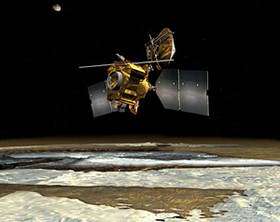
Image: In this artist's concept of the Mars Reconnaissance Orbiter, the spacecraft orbits above the martian poles. Credit: NASA/JPL
This summer, when the Red Planet and Earth again swing closer together, NASA will embark on its most exciting and promising mission to the planet yet. The Mars Reconnaissance Orbiter will launch in August aboard an Atlas V rocket from Cape Canaveral Air Force Station, Fla.
Mars Reconnaissance Orbiter will build on the discoveries and technological lessons of previous Mars missions as it examines the planet's landscape and scopes out potential future landing sites. From its lofty vantage point in martian orbit, it will observe Mars in more detail than any mission before. It will also provide a communication relay for future Mars missions.
With its suite of innovative scientific instruments, the orbiter will be looking at an ambitious set of science objectives to "follow the water," making the mission an important part of the NASA Mars Exploration Program. The overall goal is to shed light on the Red Planet's changing climate, geologic history and potential ability to harbor life.
The Mars Climate Sounder and Mars Color Imager will provide data to characterize the planet's global atmosphere and weather, and will also characterize the climate and how it changes from season to season and from year to year.
Looking through the atmosphere to Mars' dusty surface, the Compact Reconnaissance Imaging Spectrometer for Mars will investigate the complex terrain on Mars and identify water-related landforms. The High Resolution Imaging Science Experiment will photograph selected targets on Mars' surface in unprecedented detail, revealing features as small as a coffee table. The Context Camera will take pictures with a wider view to provide a visual context for the close-up observations taken by the high-resolution camera and the imaging spectrometer.
The spacecraft will also peer below the martian terrain with the Shallow Radar, provided by the Italian Space Agency. This instrument will penetrate about a third of a mile below the planet's surface for information about underground layers of ice, rock and perhaps even melted water that might be accessible from the surface.
With Mars Reconnaissance Orbiter, we'll be able to explore from above areas that are too dangerous for humans or even robots. By the same token, we'll be better prepared to plan future missions to places that are not only safe for landing, but rich with scientific potential. And because NASA's Vision for Space Exploration calls for human exploration of the Moon, Mars and beyond, the lessons we learn from this next Mars mission will take on increasing significance the closer we get to those missions of the future.
So if you were captivated by the adventures of the Mars Exploration Rovers Spirit and Opportunity as they wandered the Red Planet's surface, take heart: the voyages of discovery have only just begun.
Source: NASA


