Huygens sets off with correct spin and speed
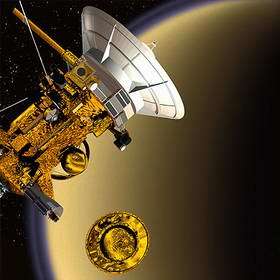
On Christmas Day 2004, the Cassini spacecraft flawlessly released ESA’s Huygens probe, passing another challenging milestone for Cassini-Huygens mission. But, with no telemetry data from Huygens, how do we know the separation went well?
At 3:00 CET on 25 December, the critical sequence loaded into the software on board Cassini was executed and, within a few seconds, Huygens was sent on its 20-day trip towards Titan. As data from Cassini confirm, the pyrotechnic devices were fired to release a set of three loaded springs, which gently pushed Huygens away from the mother spacecraft. The probe was expected to be released at a relative velocity of about 0.35 metres per second with a spin rate of about 7.5 revolutions per minute.
Telemetry data from Cassini confirming the separation were collected by NASA’s Deep Space Network stations in Madrid, Spain, and Goldstone, California, when the telemetry playback signal from Cassini eventually reached the Earth.
However, these data showed only that the Cassini systems had worked, and that the Cassini ‘attitude perturbation’ (how Cassini moved in reaction to the probe’s release) were as expected. Within hours, the preliminary analysis of this data confirmed that Huygens was on the expected trajectory and spinning within the expected range. The spin imparted to Huygens is vitally important to ensure that the probe remains in a stable attitude and on course when it enters Titan’s atmosphere. So how could we check the spin rate was correct?
When the Huygens probe was being designed more than 10 years ago, it was required that the probe had to be magnetically ‘clean’ when switched off, meaning that any residual permanent magnetic fields must not interfere with the sensitive Cassini magnetometers. Later, when the probe was built, it was found that there was still a weak magnetic field produced, but within acceptable limits for Cassini’s magnetometer sensors.
However, because magnetic fields have a ‘direction’ as well as a strength, and this weak field was slightly off-centre, it effectively gave the probe a ‘left’ and a ‘right’ side (it behaves like a small magnet with a north and south pole). With the implication being that if you can detect this magnetic field, then you can also detect how it is rotating.
Following an initial suggestion by Jean-Pierre Lebreton, the Huygens Project Scientist, scientists on the Cassini Dual Technique Magnetometer (MAG) team, from Imperial College, London, and Braunschweig, confirmed that their instrument should be able to detect this small rotating magnetic field and plans were put in place to measure this during the probe release period.
Magnetometers are direct-sensing instruments that detect and measure both the strength and direction of magnetic fields in the vicinity of the instrument. The Cassini MAG is measuring these fields while Cassini is in orbit around Saturn as well as during the close Titan encounters. But, just after separation on 25 December, the MAG scientists detected fluctuations in the magnetic field around Cassini that could only have come from Huygens rotating and moving away.
Professor Michele Dougherty, Principal Investigator for MAG, said, “What was observed by MAG just after the probe separation on 25 December 2004, were weak but clear fluctuations in both magnetic sensors which reside on the 11-metre magnetometer boom. These fluctuations were a clear indication of the Huygens probe moving away from the Cassini orbiter. This signature confirmed the spin rate of the probe at 7.5 revolutions per minute, the ideal rate which was predicted, and that Huygens is well on its way to Titan.”
Former MAG Principal Investigator David Southwood, who is now the Director of Science at ESA, said, “Detecting the spin was immensely reassuring - not only did it show Huygens was rotating correctly, but also because the spin is directly related to the departure velocity, that Huygens was headed off at the right speed. It was really great to do it with an instrument I knew so well.”
Source: ESA


