NASA Eyes Effects of a Giant 'Brown Cloud' Worldwide
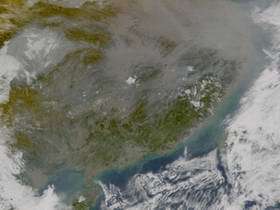
NASA scientists recently announced that a giant, smoggy atmospheric "brown cloud" that forms over South Asia and Indian Ocean has intercontinental reach, and has effects around the world.
Image: A dense blanket of polluted air hovers over central eastern China. The 'Giant Brown Cloud' is an unhealthy mix of ozone, smoke, and other particles from human activities. Click on image to view animation. Credit: NASA/ORBIMAGE
The word "smog" was coined by blending the terms "smoke" and "fog." However, today smog means air pollution. Smog is a mix of particles and unhealthy gases including ozone that linger in the lower atmosphere, or the troposphere.
Scientists studied the intercontinental smog or ozone processes associated with the "brown cloud" using a new NASA technique to combine data acquired by satellites with ozone data measured by instruments on special weather balloons. The brown cloud is a persistent, but moving, air mass characterized by a mixed-particle haze, typically brown in color. It also contains other pollution, such as ozone.
"The scientists found that both brown cloud pollution and natural processes could contribute to unhealthy levels of ozone in the lower atmosphere. Some ozone from the cloud rises to higher altitudes and spreads into the global atmosphere,” said Robert Chatfield, a scientist at NASA Ames Research Center in California’s Silicon Valley. "The ozone that comes out of the 'brown cloud' is related to it, but strictly speaking, the visible brown cloud is only the aerosol component of this smoggy stew," Chatfield explained.
"Ozone is a triple-threat player in the global environment. This form of oxygen can be good, bad or ugly. There are three very different ways that ozone affects our lives," Chatfield said.
In the upper atmosphere, or the stratosphere, ozone is very good, as it acts as a shield to protect life on Earth from harmful Ultraviolet sunlight. Near the Earth's surface, ozone or smog, can burn our lungs and damage crops.
The ozone-monitoring instrument on the NASA Aura satellite is providing new data about the 'brown cloud.' "The beautiful, high-detail images from this new instrument promise to help us sort out our major questions about how much of the tropospheric ozone is from pollution and how much is from natural factors," said Chatfield.
This new study looks at ozone as a greenhouse gas, one that can warm the planet. "The ozone pollution we studied also adds to heating effects, which take place throughout the lower atmosphere," Chatfield stated.
Analysis shows that ozone in the lower atmosphere over the Indian Ocean comes from the intensely developed industrial-agricultural area in the region. The southern pollutant buildup has long-range effects, often traveling across Africa, far beyond the main brown cloud of particles.
The scientists' analysis concurs with previous researchers' judgments – both smoggy ozone and smoggy brown aerosol allow for quick and relatively low-cost fixes compared to carbon dioxide.
The ozone-monitoring instrument on the NASA Aura satellite is providing scientists with new data about the brown cloud. The high-detail images from the new instrument promise to help scientists address major questions that include 'what is pollution?' and 'what is natural?'"
Source: NASA (by Rob Gutro, Goddard Space Flight Center)


