NASA Tests Novel Supersonic Inlet
June 7, 2004

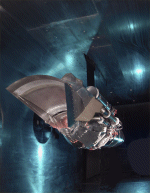
NASA parametric inlet

An advanced high-speed inlet for propulsion systems to power air transport vehicles at supersonic speeds has completed testing at NASA's Glenn Research Center, Cleveland.


Tests during the last two weeks helped refine the inlet's performance through adjustments to the inlet geometry. "Compared to typical inlets in this operating range, tests showed high pressure recovery, low cowl drag, reduced complexity, increased safety, significant manufacturing cost reduction and weight, as well as increased efficiency," said David Lam, project manager for the inlet's tests.

With potential applications to supersonic cruise vehicles, NASA has vigorously pursued an alternative to previously used inlet designs.

Nearly 75 hours of testing of the inlet late last year confirmed the advantages of the Parametric Inlet. Unlike typical inlets for supersonic cruise that rely on a mix of external and internal compression, this inlet accomplishes all of the supersonic compression externally. Comparable performance to typical inlets was shown to be possible, with the added benefits of relatively lower weight and the elimination of unstart, which is a recurring problem in propulsion systems with mixed compression inlets.

Unstart occurs in mixed compression supersonic inlets due to the mismatch between the inlet air supply flow and the engine required flow resulting in shock waves that are violently expelled from the engine. This often results in compressor stall combustor blowout and large increases in drag, which in turn decreases efficiency. Additional aircraft structure and larger control surfaces are necessary to allow for the possibility of inlet unstart.

"NASA's tests of its Parametric Inlet have proven that this type inlet can operate safely in the flow regime normally reserved for mixed compression inlets," said Dave Davis, inlet test research engineer at Glenn.

Four years ago, conceptual design of the Parametric Inlet was jointly conceived by Boeing Aircraft, Seattle, Wash., and TechLand Research, Inc., North Olmsted, Ohio, which received NASA funding through its Small Business Innovative Research (SBIR) program. The inlet came to be known as the Parametric Inlet due to the wide range of geometric variables designed into it. After competing the three phases of the SBIR process in designing the inlet, Glenn took the lead in refining the aerodynamic lines and mechanical design, with help from TechLand. Testing of the Parametric Inlet was funded by NASA's Vehicle Systems Program. Additional funding for testing was provided by the Air Force.

For more information on other aeronautics work at NASA on the Internet, visit:

http://www.ueet.nasa.gov/
http://www.grc.nas … e/psbase.htm

A photo of the Parametric Inlet can be found at:
http://www.grc.nas … 038addm.html

For the original release visit http://www.grc.nas … /04-038.html


Rank 2 /5 (2 votes)
Tags

Relevant PhysicsForums posts

More news stories

Is a classical electrodynamics law incompatible with special relativity?

(Phys.org) -- The laws of classical electromagnetism that were developed in the 19th century are the same laws that scientists use today. They include Maxwell’s four equations along with the Lorentz la ...

Physics / General Physics

created May 24, 2012 | popularity 4.7 / 5 (18) | comments 43 | with audio podcast feature

Landmark calculation clears the way to answering how matter is formed

(Phys.org) -- An international collaboration of scientists, including Thomas Blum, associate professor of physics, is reporting in landmark detail the decay process of a subatomic particle called a kaon – ...

Physics / General Physics

created May 25, 2012 | popularity 4.3 / 5 (22) | comments 53 | with audio podcast

Lying in wait for WIMPs: Researchers seek to dramatically increase sensitivity of Large Underground Xenon detector

Although it's invisible, dark matter accounts for at least 80 percent of the matter in the universe. No one knows what it is, but most scientists would bet on weakly interacting massive particles, or WIMPs.

Physics / General Physics

created May 23, 2012 | popularity 4 / 5 (7) | comments 18 | with audio podcast

Hawaii lab turns laser-powered bubbles into microrobots

(Phys.org) -- A team of scientists from the University of Hawaii are working on microrobots created from bubbles of air in a saline solution. The bubbles take on their title of “robots” as a laser ...

Physics / General Physics

created May 23, 2012 | popularity 5 / 5 (4) | comments 2 | with audio podcast weblog

Sound increases the efficiency of boiling

Scientists at the Georgia Institute of Technology achieved a 17-percent increase in boiling efficiency by using an acoustic field to enhance heat transfer. The acoustic field does this by efficiently removing vapor bubbles ...

Physics / Soft Matter

created May 24, 2012 | popularity 5 / 5 (2) | comments 2


Stunning image of smallest possible five-ringed structure

Scientists have created and imaged the smallest possible five-ringed structure – about 100,000 times thinner than a human hair – and you'll probably recognise its shape.

'Unzipped' carbon nanotubes could help energize fuel cells, batteries

Multi-walled carbon nanotubes riddled with defects and impurities on the outside could replace some of the expensive platinum catalysts used in fuel cells and metal-air batteries, according to scientists at ...

Change in developmental timing was crucial in the evolutionary shift from dinosaurs to birds: study

At first glance, it's hard to see how a common house sparrow and a Tyrannosaurus Rex might have anything in common. After all, one is a bird that weighs less than an ounce, and the other is a dinosaur that ...

Computer model used to pinpoint prime materials for efficient carbon capture

When power plants begin capturing their carbon emissions to reduce greenhouse gases – and to most in the electric power industry, it's a question of when, not if – it will be an expensive undertaking.

T cells 'hunt' parasites like animal predators seek prey, study shows

By pairing an intimate knowledge of immune-system function with a deep understanding of statistical physics, a cross-disciplinary team at the University of Pennsylvania has arrived at a surprising finding: T cells use a movement ...

Land and sea species differ in climate change response: study

(Phys.org) -- Marine and terrestrial species will likely differ in their responses to climate warming, new research by Simon Fraser University and Australia’s University of Tasmania has found.