Team Visits Chile on Quest for Rare Fuel-Producing Microorganism
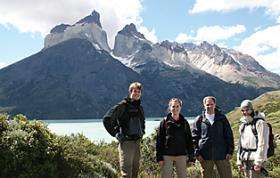
(PhysOrg.com) -- Three Yale graduate students recently were part of an expedition to Chile to find a rare microorganism that can produce diesel fuel.
A year ago, the last place that three Yale graduate students would have expected to find themselves was in Chile, hunting for obscure microorganisms within Patagonian plants that possess the peculiar — and potentially valuable — ability to produce diesel fuel.
But this December, graduate students Daniel Spakowicz, Meghan Griffin and Tara Gianoulis found themselves crashing through brush looking for rare ulmo trees that may harbor the biochemical secrets of an alternate fuel source for the world.
"When I first heard about the project, I spent 10 minutes thinking about whether to join," says Spakowicz. "And then I gladly signed my life away."
Last spring, when he was a graduate student looking for a lab to join, Spakowicz was approached by Scott Strobel, the Henry Ford II Professor and chair of the Department of Molecular Biophysics and Biochemistry, who had a proposition: Would Spakowicz be interested in doing a genetic and chemical analysis of a fungal microorganism found in Chile years earlier by the Yale professor's father, Gary Strobel?
The elder Strobel is a professor at Montana State University and a world expert on endophytes, a little-studied class of microorganism found within plant tissue. These fungal and bacterial endophytes can possess some intriguing bioactive qualities. One discovered by the elder Strobel in a yew tree, for instance, produced the blockbuster cancer drug Taxol.
The Chilean endophyte, the fungus Gliocladium roseum, is able to produce hydrocarbons, Gary Strobel told his son last March during a endophyte-hunting class trip to the Amazon with a dozen Yale undergraduates. He asked his son: Would one of your students like to analyze the fungus?
Spakowicz had majored in both ecology and biochemistry, and he jumped at the chance to use his expertise in both disciplines. Scott Strobel also enlisted another first-year graduate student who worked in his lab, Meghan Griffin. As an undergraduate, Griffin focused on natural product biosynthesis, particularly the role of bacterial enzymes in the production of potential anti-tumor agents. Griffin and Spakowicz began to investigate the properties of Gary Strobel's curious endophtye.
By fall, the two were contributing authors with Strobel on a paper published in the journal Microbiology that reached this conclusion: The endophyte-produced hydrocarbons were chemically indistinguishable from diesel fuels. The endophyte does not produce a lot of fuel, say the scientists, but the implications are clear: Discover the secret of the organism's fuel-making capabilities and an energy-hungry world might have another source of fuel.
The Strobels planned a trip to Chile to look for more samples of the endophyte. They hoped to find a genetic variant that produced diesel more efficiently or — almost as good — an example of the same endophyte that produced no diesel at all.
"Then finding the genetic mechanism involved would be relatively easy," explains Spakowicz.
That hope led to the recruitment of a third graduate student, Tara Gianoulis. She was busy preparing for her doctorate in computational biology and bioinformatics - specifically, relating gene sequence data from microbial communities (metagenomics) to data describing different marine environments in which they lived. She had already been part of a project that sequenced an infectious microorganism, Acinetobacter baumannii, and further had identified regions that were potentially pathogenic.
In a search for molecular mechanisms behind the production of diesel, her expertise with large-scale comparative genomic analysis and machine learning would be crucial, the team concluded.
Despite her heavy workload, Gianoulis jumped at the chance.
"I studied snake evolution as an undergraduate, and just before my first, and only, chance to do fieldwork, I sprained my ankle and could not go," she says. "I was ecstatic to finally get to go do fieldwork, and endophytes are a lot safer than poisonous snakes."
The five-person team started their Chilean adventure in the southern reaches of Patagonia, a more alpine habitat, and headed northward into a progressively wetter and more tropical environment. The trio climbed over trees, stared through the ends of downed logs and scoured small patches of ground looking for signs of anything biologically interesting. Sometimes, under flicking generator lights, they spent the evening identifying plants using headlamps.
"I had never realized before just how diverse plant life was until sitting there counting the number of veins on a leaf, estimating angles, poring over our field notes by headlamp with the lights flickering in the background," Gianoulis says.
In an attempt to slow down the tireless Gianoulis, Spakowicz recalls, he once filled Tara's backpack with rocks — an effort that he admits ultimately failed.
It was in northern Patagonia where Gary Strobel had first found his peculiar endophyte that the group found the Ulmo trees from which the original organism had been isolated.
Now back in New Haven, the three graduate students have begun isolating microorganisms from the approximately 100 samples of plant tissue they brought back with them from South America. Preliminary results suggest they may have found more samples of the endophyte Gary Strobel stumbled upon so many years before.
Being involved in research that took her from the jungle to a New Haven laboratory bench was a revelation for Griffin.
"Now that I have seen the incredible possibilities of linking both lab and field work, I would very much like to continue," Griffin says. "It adds a completely new layer to my scientific experience."
The real quest to uncover secrets of microorganisms is just beginning, say the scientists. The endophytes have potential to produce cancer drugs as well as fuel. Some also possess antibiotic and anti-inflammatory properties. Furthermore, there have been few studies of these organisms, opening up a career's worth of opportunities for young scientists.
"The questions are so big, so-open ended. We will be working on this for years," Spakowicz says.
Provided by Yale University


