Enzyme with a Sugar Antenna: Researchers achieve semisynthesis of homogeneous glycoproteins
(PhysOrg.com) -- More than half of all human proteins, as well as many important pharmaceutical agents, are glycoproteins, which means that they contain sugar components. In general, natural glycoproteins do not have a homogeneous sugar component. With modern purification techniques, it is practically impossible to isolate sufficient quantities of homogeneous glycoproteins for systematic biomedical studies.
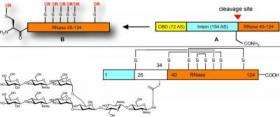
Synthesis in the lab is a good alternative—but also a very complex task. As they report in the journal Angewandte Chemie, scientists led by Carlo Unverzagt at the University of Bayreuth (Germany) have now successfully used a new strategy to synthesize ribonuclease C (RNase C), a glycosylated bovine pancreatic enzyme.
Sugar components play an important role in the water solubility, stability, and folding of glycoproteins. In addition, they participate in molecular -recognition processes, such as cell adhesion or the interaction of host cells with pathogens. The same protein with different sugar moieties can thus have different functions. RNase is an enzyme that occurs in various glycosylated forms. Because this enzyme has been intensively investigated before, it makes an interesting model system for research. RNase C contains a complex sugar component in the form of a double-ended “antenna”.
The conventional solid-phase synthesis used to build up peptides one amino acid at a time is much too complex for long peptide chains and sometimes doesn’t work at all because of side reactions. Unverzagt and his team thus built up RNase C sequentially from several fragments, connecting them by using “native chemical ligation”. In this technique, one peptide fragment is attached to the terminal cysteine group (sulfur-containing amino acid) of a second peptide fragment by means of a thioester group—a selective reaction that results in a natural peptide bond.
The researchers used solid-phase synthesis to make the critical peptide fragment that has the sugar antenna. Another fragment was obtained bacterially by means of a method derived from protein splicing. In this process, a protein sequence (intein) is autocatalytically split off from a fusion protein generated in a cell culture. The difficulty: as well as a terminal cysteine group, this protein fragment contains seven additional cysteines. Their sulfur-hydrogen groups are extremely reactive and sensitive toward oxidation. In order to protect them, they were “sealed off” as mixed disulfides. These protective groups could be easily removed afterwards.
Thanks to sophisticated techniques, the team was finally able to correctly attach the individual fragments, fold the enzyme into its natural form, and correctly couple the cysteines into disulfide bridges to form a functional RNase C.
Citation: Carlo Unverzagt, Semisynthesis of a Homogeneous Glycoprotein Enzyme: Ribonuclease C, Angewandte Chemie International Edition, doi: 10.1002/anie.200804734
Provided by Wiley


