Matrix fragments trigger fatal excitement
Dec 29, 2008
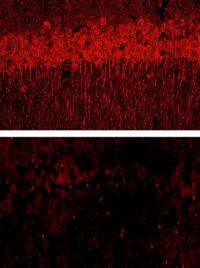
The extracellular matrix thins in mice lacking laminin in the hippocampus (bottom). Credit: Chen, Z.-L., et al. 2008. J. Cell Biol.

Shredded extracellular matrix (ECM) is toxic to neurons. Chen et al. reveal a new mechanism for how ECM demolition causes brain damage. The study will appear in the December 29, 2008 issue of The Journal of Cell Biology.

A stroke or head injury kills large numbers of neurons through a process called excitotoxicity. A surge of the neurotransmitter glutamate jolts receptors such as the kainate receptor and stimulates cell death. Enzymes add to the death toll by chopping up ECM near the injury site. How ECM breakdown takes out neurons was mysterious. The standard view was that neurons perished because they got separated from the ECM as it dissolved.

Chen et al. found otherwise when they engineered mice to lack the ECM component laminin in the hippocampus, a brain region often damaged by stroke or injury. If cells languished after parting from the ECM, the researchers reasoned that mice missing laminin would suffer more damage from excitotoxicity. But when excitotoxicity was spurred with an injection of kainate—a molecule that, like glutamate, activates the kainate receptor—the laminin-lacking mice showed less brain damage. After a dose of diced laminin, however, the mutant mice were vulnerable to kainate, indicating that the fragments are the culprit in cell death.

The researchers discovered that chopped-up ECM kills cells by ramping up production of one subunit of the kainate receptor, known as KA1. They speculate that hiking the amount of KA1 subunits might make the receptor more sensitive and thus more likely to trigger an overreaction by the cell.

Although drugs that obstruct the glutamate receptor slow brain cell death, they can lead to serious cognitive impairment and even coma. The study suggests that drugs that block KA1 might provide an alternative way to save brain cells after stroke or head trauma.

Paper: Chen, Z.-L., et al. 2008. J. Cell Biol. doi:10.1083/jcb.200803107, www.jcb.org

Source: Rockefeller University

Explore further: Encouraging signs for bee biodiversity

add to favorites email to friend print save as pdf

Related Stories

X-ray tomography on a living frog embryo

May 16, 2013

Classical X-ray radiographs provide information about internal, absorptive structures of organisms such as bones. Alternatively, X-rays can also image soft tissues throughout early embryonic development of ...

Which came first the head or the brain?

Mar 28, 2013

(Phys.org) —A fundamental question in the evolution of animal body plans, is where did the head come from? In animals with a clear axis of right-left symmetry, the bilaterians, the head is where the brain ...

Recommended for you

Encouraging signs for bee biodiversity

4 hours ago

Declines in the biodiversity of pollinating insects and wild plants have slowed in recent years, according to a new study. Researchers led by the University of Leeds and the Naturalis Biodiversity Centre in the Netherlands ...

User comments : 0

More news stories

Encouraging signs for bee biodiversity

Declines in the biodiversity of pollinating insects and wild plants have slowed in recent years, according to a new study. Researchers led by the University of Leeds and the Naturalis Biodiversity Centre in the Netherlands ...

If you can remember it, you can remember it wrong

(Medical Xpress)—Native peoples in regions where cameras are uncommon sometimes react with caution when their picture is taken. The fear that something must have been stolen from them to create the photo ...

B vitamins could delay dementia

(Medical Xpress)—Despite spending billions of dollars on research and development, drug companies have been unable to come up with effective treatments for dementia and Alzheimer's Disease (AD). Now, A. ...

New method for producing clean hydrogen

Duke University engineers have developed a novel method for producing clean hydrogen, which could prove essential to weaning society off of fossil fuels and their environmental implications.