Pollinator decline not reducing crop yields just yet
Nov 10, 2008
Pollinator decline not reducing crop yields just yet
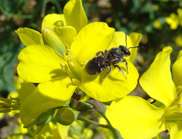
There is as yet no evidence that global pollinator decline is limiting global food production. Photo by: Sujaya Rao, CSIRO

(PhysOrg.com) -- The well-documented worldwide decline in the number of bees and other pollinators is not, at this stage, limiting global crop yields, according to the results of an international study published in the latest edition of the respected science journal, Current Biology.

Co-author, CSIRO Entomology’s Dr Saul Cunningham, says however that the study detected warning signs that demand for pollinators is still growing and some highly pollinator-dependant crops are suffering.

“The research team scored crops on how much they depend on pollinators for maximum production,” Dr Cunningham says. “Depending on the crop, this dependence ranges from zero to 100 per cent. For example, cereal crops like wheat don’t need to be pollinated but at the other end of the scale, unpollinated almond trees produce no nuts.”

The team found that between 1961 and 2006 the yields of most crops have consistently grown at about 1.5 per cent a year because of improvements in agriculture. There was also no difference in yield growth between crops that require pollinators and those that do not

“While this is a positive finding, the interaction between yields and pollination is a hugely complex issue which needs to be teased-out further,” Dr Cunningham says. “Global summaries can also hide local stories. In some places, local pollinator shortages are affecting local production. While these don’t threaten overall global food supplies, they can have very significant impacts on local communities and their economies.”

The researchers were surprised to discover that there has been a global increase in the growing of pollinator-dependent crops, particularly in the developing world.

“The fact that, while pollinators are declining in various parts of the world, global agricultural systems are becoming more dependent on pollinators, could create serious problems in the future,” Dr Cunningham says.

When the group looked at pollinated crops in more detail, they found that pollinator shortages might be beginning to affect crops that rely heavily on pollination because their yield growth was lower than for crops that were less dependent.

Dr Cunningham says they now want to examine how declining pollinator supply might be increasing the costs of production. Increased yields are usually the result of increasing farm inputs such as fertiliser, labour and water. For some crops, this increasingly intensive management may have, for now, overcome any losses in pollinator service, but it also increases production costs. There is also evidence that one response to lower yield growth for highly pollinator dependent crops is a growing demand for land.

Citation: Aizen Marcelo A, Garibaldi Lucas A, Cunningham, Saul A & Klein Alexandra M. (2008) Long-Term Global Trends in Crop Yield and Production Reveal No Current Pollination Shortage but Increasing Pollinator Dependency. Current Biology 18: 1-4.

Provided by CSIRO

Explore further: CU-Boulder helps tap crowds to digitize museum records of bugs and plants

add to favorites email to friend print save as pdf

Related Stories

Wildlife losses now stabilising

3 hours ago

Efforts to conserve biodiversity in the UK, Belgium and Netherlands may be working, despite the widespread perception that wildlife is in terminal decline, a new study suggests.

Encouraging signs for bee biodiversity

May 21, 2013

Declines in the biodiversity of pollinating insects and wild plants have slowed in recent years, according to a new study. Researchers led by the University of Leeds and the Naturalis Biodiversity Centre in the Netherlands ...

Scientists see if bees 'are what they eat'

May 08, 2013

(Phys.org) —In a paper published today in the peer-reviewed science journal PLoS ONE, researchers have presented a new model to explore how changes in food availability might influence honeybee colony growth ...

Sacred lotus genome sequence enlightens scientists

May 10, 2013

The sacred lotus (Nelumbo nucifera) is a symbol of spiritual purity and longevity. Its seeds can survive up to 1,300 years, its petals and leaves repel grime and water, and its flowers generate heat to att ...

Nearly one in three US honeybees lost in winter 2012-13

May 08, 2013

(Phys.org) —U.S. beekeepers lost nearly one in every three honey bee colonies over the winter of 2012-2013, according to an annual survey conducted by the Bee Informed Partnership and the Apiary Inspec ...

Bees survival: Ban more pesticides?

May 03, 2013

Neonicotinoids are under intense scrutiny. But a ban of a broad variety of pesticides may be required to protect bees, humans and the environment.

Recommended for you

Researcher admits mistakes in stem cell study

1 hour ago

A blockbuster study in which US researchers reported that they had turned human skin cells into embryonic stem cells contained errors, its lead author has acknowledged. ...

Scientists discover how rapamycin slows cell growth

3 hours ago

University of Montreal researchers have discovered a novel molecular mechanism that can potentially slow the progression of some cancers and other diseases of abnormal growth. In the May 23 edition of the prestigious journal ...

Bittersweet: Bait-averse cockroaches shudder at sugar

5 hours ago

Sugar isn't always sweet to German cockroaches, especially to the ones that avoid roach baits. In a study published May 24 in the journal Science, North Carolina State University entomologists show the ne ...

User comments : 0

More news stories

Scientists discover how rapamycin slows cell growth

University of Montreal researchers have discovered a novel molecular mechanism that can potentially slow the progression of some cancers and other diseases of abnormal growth. In the May 23 edition of the prestigious journal ...

Future doctors unaware of their obesity bias

Two out of five medical students have an unconscious bias against obese people, according to a new study by researchers at Wake Forest Baptist Medical Center. The study is published online ahead of print in the Journal of ...

WHO: Scientific red tape mars efforts vs. virus

International efforts to combat a new pneumonia-like virus that has now killed 22 people are being slowed by unclear rules and competition for the potentially profitable rights to disease samples, the head ...