Biologists discover motor protein that rewinds DNA
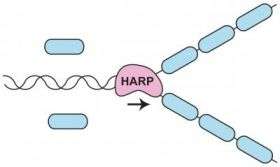
Two biologists at the University of California, San Diego have discovered the first of a new class of cellular motor proteins that "rewind" sections of the double-stranded DNA molecule that become unwound, like the tangled ribbons from a cassette tape, in "bubbles" that prevent critical genes from being expressed.
"When your DNA gets stuck in the unwound position, your cells are in big trouble, and in humans, that ultimately leads to death" said Jim Kadonaga, a professor of biology at UCSD who headed the study. "What we discovered is the enzyme that fixes this problem."
The discovery represents the first time scientists have identified a motor protein specifically designed to prevent the accumulation of bubbles of unwound DNA, which occurs when DNA strands become improperly unwound in certain locations along the molecule.
The UCSD researchers' findings, detailed in the October 31 issue of Science, are also important because they provide biomedical scientists with a greater understanding of the molecular mechanisms that lead to a rare genetic disorder called Schimke immuno-osseous dysplasia. The discovery will eventually allow medical researchers to design future treatments for this devastating genetic disorder, which causes strokes, congestive heart failure, kidney failure and death in young children.
"We knew this particular protein caused this disease before we started the study," said Kadonaga. "That's why we investigated it. We just didn't know what it did."
What this protein, called HARP for HepA-related protein, did astounded Kadonaga and Timur Yusufzai, a postdoctoral fellow working in his laboratory. The two molecular biologists initially discovered that this motor protein burns energy in the same way as enzymes called helicases and, like helicases, attached to the dividing sections of DNA. But while helicases use their energy to separate two annealed nucleic acid strands—such as two strands of DNA, two strands of RNA or the strands of a RNA-DNA hybrid— the scientists found to their surprise that this protein did the opposite; that is, it rewinds sections of defective DNA and thus seals the two strands together again.
As a consequence, the UCSD biologists termed their new enzyme activity an "annealing helicase."
"We didn't even consider the idea of annealing helicases before this study started," said Kadonaga. "It didn't occur to us that such enzymes even existed. In fact, we never knew until now what happened to DNA when it got stuck in the unwound position."
Now scientists who study the action of helicases on DNA and RNA have an entirely new class of proteins to investigate.
"This will open up a whole new area of study," said Kadonaga. "There are very few enzymes known that alter DNA structure. And we've discovered an entirely new one. This was not expected to happen in the year 2008. We should have found them all by now."
"I believe it's going to go beyond DNA. Just as there are DNA-DNA helicases, there are RNA-DNA helicases and RNA-RNA helicases. So it doesn't take a lot of imagination to foresee that there are probably going to be RNA-DNA annealing helicases and RNA-RNA annealing helicases. The field potentially can be fairly large. And as more and more people discover additional annealing helicases, this field will expand."
Kadonaga and Yusufzai are already searching for more annealing helicases, but they also plan to continue their studies of HARP.
"First, we want to do is find more of these proteins, so we're looking for more right now," said Kadonaga. "We also want to see what other specific processes are affected by this particular protein, HARP, in the cell."
Source: University of California - San Diego


