LEDs may help reduce skin wrinkles, researchers report
Oct 20, 2008
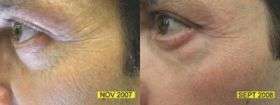
LEDs may help reduce skin wrinkles, researches report. Credit: American Chemical Society

Researchers in Germany are describing a potential alternative to Botox and cosmetic surgery for easing facial wrinkles. Their study, scheduled for the November 5 issue of ACS' Crystal Growth & Design reports that high intensity visible light from light emitting diodes (LEDs) applied daily for several weeks resulted in "rejuvenated skin, reduced wrinkle levels, juvenile complexion and lasting resilience." LEDs are the miniature lights used in an array of products, from TV remote controls to traffic lights.

In the study, Andrei P. Sommer and Dan Zhu point out that high-intensity visible light has been used in medicine for more than 40 years to speed healing of wounds. That light actually penetrates into the skin, causing changes in the sub-surface tissue. Until now, however, scientists have not known the physicochemical nature of those changes.

They report identifying how the visible light works — by changing the molecular structure of a glue-like layer of water on elastin, the protein that provides elasticity in skin, blood vessels, heart and other body structures.

Figuratively speaking, the light strips away those water molecules that are involved in the immobilization of elastin, gradually restoring its elastic function and thus reducing facial wrinkles. "We are justified in believing that our approach can be easily converted to deep body rejuvenation programs," the researchers state.

Article: "From Microtornadoes to Facial Rejuvenation: Implication of Interfacial Water Layers", dx.doi.org/10.1021/cg8000703

Source: American Chemical Society

Explore further: Attacking MRSA with metals from antibacterial clays

add to favorites email to friend print save as pdf

Related Stories

Continuous monitoring of UV exposure

Apr 29, 2013

UV lamps are used to cure coatings and adhesives in many industrial manufacturing processes. And special sensors are used to measure the intensity of the UV light applied to these surfaces. But because these ...

Iron Age warriors point to glories of Gaul

Apr 14, 2013

In a muddy field located between a motorway and a meander of the Seine southeast of Paris, French archaeologists have uncovered an Iron Age graveyard that they believe will shed light on the great yet enigmatic ...

Saturn is like an antiques shop, Cassini suggests

Mar 27, 2013

(Phys.org) —A new analysis of data from NASA's Cassini spacecraft suggests that Saturn's moons and rings are gently worn vintage goods from around the time of our solar system's birth.

Recommended for you

Attacking MRSA with metals from antibacterial clays

May 17, 2013

In the race to protect society from infectious microbes, the bugs are outrunning us. The need for new therapeutic agents is acute, given the emergence of novel pathogens as well as old foes bearing heightened antibiotic resistance.

Beautiful 'flowers' self-assemble in a beaker

May 16, 2013

By simply manipulating chemical gradients in a beaker of fluid, materials scientists at Harvard have found that they can control the growth behavior of crystals to create precisely tailored structures—such ...

Reading the unreadable

May 16, 2013

Pioneering X-ray technology is making it possible to read fragile rolled-up historical documents for the first time in centuries.

Keeping fruit, vegetables and cut flowers fresh longer

May 15, 2013

New technology offers the promise of reducing billions of dollars of losses that occur each year from the silent, invisible killer of fruits, vegetables and cut flowers—a gas whose effects are familiar to everyone who has ...

User comments : 3

Adjust slider to filter visible comments by rank

Display comments: newest first

barakn
3 / 5 (6) Oct 20, 2008
I love it when they take before and after photos using different lighting conditions so you can't actually tell what's going on. It boosts my confidence in their findings.
h0dges
5 / 5 (2) Oct 20, 2008
My thoughts exactly.
deatopmg
not rated yet Oct 21, 2008
Interesting paper and the first in 45 yrs I've ever seen FREE from the ACS. There must be some mistake.

More news stories

Attacking MRSA with metals from antibacterial clays

In the race to protect society from infectious microbes, the bugs are outrunning us. The need for new therapeutic agents is acute, given the emergence of novel pathogens as well as old foes bearing heightened antibiotic resistance.

Beautiful 'flowers' self-assemble in a beaker

By simply manipulating chemical gradients in a beaker of fluid, materials scientists at Harvard have found that they can control the growth behavior of crystals to create precisely tailored structures—such ...

Making gold green: New non-toxic method for mining gold

Northwestern University scientists have struck gold in the laboratory. They have discovered an inexpensive and environmentally benign method that uses simple cornstarch—instead of cyanide—to isolate gold from raw materials ...