Future impact of global warming is worse when grazing animals are considered, scientists suggest
The impact of global warming in the Arctic may differ from the predictions of computer models of the region, according to a pair of Penn State biologists. The team -- which includes Eric Post, a Penn State associate professor of biology, and Christian Pederson, a Penn State graduate student -- has shown that grazing animals will play a key role in reducing the anticipated expansion of shrub growth in the region, thus limiting their predicted and beneficial carbon-absorbing effect. The team's results will be published in the online Early Edition of the journal Proceedings of the National Academy of Sciences sometime between 18 and 22 August 2008.
Most computer models indicate that shrubs will thrive and spread as a result of global warming. And because shrubs have an increased ability over grasses and other small plants to absorb the greenhouse gas carbon dioxide, many scientists believe that shrubs will absorb some of this carbon dioxide and, thereby, lessen the impact of climate change. While Post and Pederson agree that global warming will promote the growth of shrubs, they argue that grazing by muskoxen and caribou will reduce the carbon-mitigating benefit of the plants.
"If you imagine a chessboard on which the dark squares are shrubs and the light squares are grasses, warming alone would tend to increase the size of the dark squares until the chess board is completely filled in," said Post. "Our experiment suggests that herbivores, like caribou and muskoxen, will slow this process, inhibit it, or perhaps even increase the size of the white squares on the chessboard."
The researchers conducted a novel five-year experiment in West Greenland in which they compared the effects of grazing by muskoxen and caribou in plots treated with increased temperatures versus those left untreated. The scientists used warming chambers to increase temperatures in certain plots. Like miniature open-topped greenhouses, the warming chambers inhibit the flow of air across the surface of the ground, thus reducing the cooling effect of wind and allowing warm air to accumulate inside the chamber.
To document the effects of warming alone on vegetation, the scientists constructed fences around several plots to exclude muskoxen and caribou. They found that warming did, indeed, promote the growth of shrubs, but they also found that, in the warmed plots outside the fences, muskoxen and caribou reduced this growth by 19 percent. In particular, the animals reduced the growth of dwarf birch by 46 percent and of willow by 11 percent.
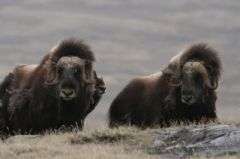
Post's research also revealed that muskoxen -- rather than the more numerous caribou -- were responsible for most of the grazing. "This discovery is quite surprising, considering that muskoxen occur at such a low density at our site," said Post, who added that the result may be due to the sedentary nature of Muskoxen which, in contrast to caribou, tend to graze in one location for long periods of time. Muskoxen at Post's site also occur at lower densities than they do elsewhere in Greenland, Canada, and Alaska, so Post suspects that the effects of grazing in other areas could be even more pronounced.
"Careful management and conservation of existing populations of muskoxen and caribou, as well as other large herbivores, should be a priority in plans to mitigate the effects of climate change on ecosystems," said Post. "Until now, these animals seem to have been regarded more as background noise than as an active component of the ecosystem's response to warming."
In addition to the impact of muskoxen and caribou, Post and Pederson also measured the impact of an unexpected moth outbreak on vegetation in their plots. They found that by munching on the leaves and stems of plants, the moths contributed significantly to the reduction of live plant tissues.
"Our results suggest that herbivores in the Arctic and elsewhere may constrain the increase in shrub growth that is projected by current models of global warming. Their grazing could have important consequences for the ability of shrubs to reduce atmospheric carbon dioxide. Insect outbreaks may become more frequent with future warming, as well, and our results also suggest an important role of such outbreaks in reducing shrubs," said Post. "On the practical and policy sides of this story, we need to be aware that the 'carbon dioxide sponge' -- represented especially by shrubs and trees -- may not be as big as we thought it was. This finding is yet another reason to think carefully about reducing carbon-dioxide emissions."
Source: Penn State


