Carbon dioxide poses risk to marine life survival
Aug 06, 2008
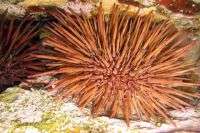
Heliocidaris erythogramma.

(PhysOrg.com) -- Climate change and the subsequent acidification of the world's oceans will significantly reduce the successful fertilisation of certain marine species by the year 2100, an international team of biological scientists has found.

A team from Macquarie University's marine ecology group, led by Dr Jane Williamson, joined forces with the University of Gothenburg in Sweden to study the effects of seawater acidification on sea urchin fertility for the first time, finding a link between decreased pH (increased acid) levels and a reduction in sperm swimming speed and motility.

Williamson said sea urchin gametes and larvae used in the research were exposed to the same acid levels that are predicted to be present in the world's oceans by the year 2100.

The surface of the ocean absorbs up to 30 per cent of the yearly emissions of carbon dioxide. This absorbed carbon dioxide dissolves in the water and forms a weak acid that is gradually increasing the acidity of the oceans.

"It is widely believed that seawater is chemically well-buffered, but these results show that the acidification process already well underway may threaten the viability of many marine species," Williamson said.

"Our results show that carbon dioxide-induced acidification of seawater, at levels predicted for the year 2100, reduced fertilisation success of an ecologically dominant marine species by 25 per cent."

The Macquarie University research is especially significant, as equivalent results have only previously been found at far more extreme levels of acidification.

"What we have now is evidence that the world's marine life is far more sensitive to ocean acidification than first suspected, and that means our oceans may be very different places in the not too distant future," Williamson said.

Researchers measured sperm swimming speed, sperm motility, fertilisation success and larval developmental success in individual male x female crosses in the Heliocidaris erythrogramma species using control (pH 8.1) and acidified (pH 7.7) seawater.

The Heliocidaris erythrogramma species is found commonly in inshore waters around south-eastern Australia.

The findings of the Macquarie University study will be published in the August 5 issue of science journal, Current Biology (www.current-biology.com).

Provided by Macquarie University

Explore further: 2 miniature spider species discovered in Giant Panda Sanctuaries of China

add to favorites email to friend print save as pdf

Related Stories

Coccoliths thrive despite ocean acidification

2 hours ago

Ocean acidification is damaging some marine species while others thrive, say scientists. An international team studied the effect of ocean acidification on plankton in the North Sea over the past forty years, ...

Why we need to put the fish back into fisheries

May 20, 2013

Overfishing has reduced fish populations and biodiversity across much of the world's oceans. In response, fisheries are increasingly reliant on a handful of highly valuable shellfish. However, new research by the University ...

Caribbean talks conservation on Branson's island

May 17, 2013

(AP)—Surrounded by a turquoise sea and a menagerie of exotic animals on a billionaire's private island, political and business leaders gathered Friday to back an initiative aimed at expanding protection ...

Recommended for you

Drought makes Borneo's trees flower at the same time

40 minutes ago

Tropical plants flower at supra-annual irregular intervals. In addition, mass flowering is typical for the tropical forests in Borneo and elsewhere, where hundreds of different plant timber species from the ...

Fast new, one-step genetic engineering technology

46 minutes ago

A new, streamlined approach to genetic engineering drastically reduces the time and effort needed to insert new genes into bacteria, the workhorses of biotechnology, scientists are reporting. Published in ...

100K Pathogen Genome Project maps first genomes

1 hour ago

(Phys.org) —Striking a blow at foodborne diseases, the 100K Pathogen Genome Project at the University of California, Davis, today announced that it has sequenced the genomes of its first 10 infectious microorganisms, including ...

Getting to the bottom of the zombie ant phenomenon

1 hour ago

(Phys.org) —While unraveling a dramatic case of mind control, biologist David Hughes is taking calls from Hollywood—and gaining new insights into the role behavior plays in spreading disease.

User comments : 0

More news stories

Drought makes Borneo's trees flower at the same time

Tropical plants flower at supra-annual irregular intervals. In addition, mass flowering is typical for the tropical forests in Borneo and elsewhere, where hundreds of different plant timber species from the ...

Fast new, one-step genetic engineering technology

A new, streamlined approach to genetic engineering drastically reduces the time and effort needed to insert new genes into bacteria, the workhorses of biotechnology, scientists are reporting. Published in ...

DNA damage: The dark side of respiration

(Phys.org) —Adventitious changes in cellular DNA can endanger the whole organism, as they may lead to life-threatening illnesses like cancer. Researchers at LMU now report how byproducts of respiration cause mispairing ...