Modified proteins add colour to research
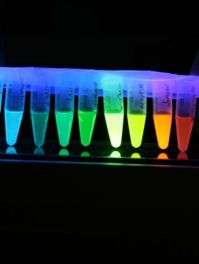
(PhysOrg.com) -- The subtleties between shades of celery or wasabi green sounds like a debate for an interior designer, but University of Alberta PhD student Huiwang Ai has been exploring those differences in a science lab.
In a unique fusion of chemistry and biology, Ai, who just successfully completed his thesis with Robert Campbell in the department of chemistry, has helped improve the colours of fluorescent proteins used by life science researchers to explore everything from cancer tumours to brain activity.
"This is very basic research that can be applied to other research in all the life sciences," said Ai. "You can use the coloured proteins to track tumour growth and investigate the mechanics of cancer-cell growth, or the mechanics of neural signals."
Ai, who will take a research position at the prestigious Scripps Research Institute in California on July 28, has spent the last few years in the U of A chemistry lab specifically developing better shades of blue and teal to light up otherwise invisible proteins under the microscope.
Derived from the DNA of coral and jellyfish, fluorescent proteins glow in a whole rainbow of colours and are used in thousands of labs worldwide to help illuminate other proteins that are invisible. This allows researchers to observe the workings of genes in everything from bacteria to plants and animals, and can help image tumour growths. This in turn allows scientists to identify potential drugs to treat diseases like cancer.
As his thesis project, Ai wanted to improve upon cyan (teal) and blue shades that would stand out more under the microscope lens. He did this by giving the natural evolution of proteins a push in the lab, speeding up the process of a million years to a matter of days. The genes were mutated and the positive characteristics of each generation were accumulated to ultimately create more brightly-hued genes.
"You can get just about any colour: red, blue, cyan, yellow, or green," said Ai.
At the same time, Ai created fluorescent proteins with better photostability, meaning the colour can last for days instead of just minutes. As well, he developed a novel method to use fluorescent proteins as molecular "beacons" to reveal two different bioactivities inside a cell.
For his work, Ai is one of 25 PhD students to receive the U of A's Andrew Stewart Memorial Graduate Prize worth $5,000. The award, named for a past U of A president, is given out each year to celebrate the research accomplishments of PhD students. Ai's work has been published in the past by the Proceedings of the National Academy of Sciences, by Nature Methods and by several other research journals, as part of joint studies.
Provided by University of Alberta


