'Snow flea antifreeze protein' could help improve organ preservation
Jul 21, 2008
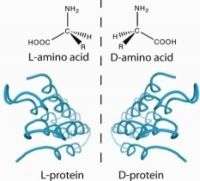
By creating an antifreeze protein found in the Canadian snow flea, scientists are reporting a development that could extend the storage life of donor organs. The figure shows representations of the unprecedented structure of the protein in its mirror image forms prepared by total chemical synthesis. Credit: Courtesy of Brad Pentelute

Scientists in Illinois and Pennsylvania are reporting development of a way to make the antifreeze protein that enables billions of Canadian snow fleas to survive frigid winter temperatures.

Their laboratory-produced first-of-a-kind proteins could have practical uses in extending the storage life of donor organs and tissues for human transplantation, the researchers indicate in a report scheduled for the July 9 issue of the Journal of the American Chemical Society.

In the study, Stephen B. H. Kent and colleagues point out that scientists have tried for years to decipher the molecular structure and produce from chemicals in a laboratory the so-called "snow flea antifreeze protein (sfAFP)." Those steps are critical for obtaining larger amounts of the protein, which exists naturally in only minute quantities in snow fleas. The larger synthetic quantities can be used for further research and potential medical and commercial uses, they say.

The researchers made synthetic sfAFP, and showed that it has the same activity as the natural protein. They also produced variants, including one form of sfAFP with a molecular architecture that is the reverse, or "mirror image," of natural sfAFP and different from any other protein found in living things on Earth. The mirror-image form of sfAFP appears less likely to trigger harmful antibodies and more resistant to destruction by natural enzymes, making it potentially more effective than the native form for use in organ and tissue preservation, the scientists note.

"Our most significant advance was the use of the two mirror image forms of the protein to determine the previously unknown crystal structure of this unique protein," said Kent. "That is a first in the history of protein X-ray crystallography."

Source: ACS

Explore further: Attacking MRSA with metals from antibacterial clays

add to favorites email to friend print save as pdf

Related Stories

Recommended for you

Attacking MRSA with metals from antibacterial clays

May 17, 2013

In the race to protect society from infectious microbes, the bugs are outrunning us. The need for new therapeutic agents is acute, given the emergence of novel pathogens as well as old foes bearing heightened antibiotic resistance.

Beautiful 'flowers' self-assemble in a beaker

May 16, 2013

By simply manipulating chemical gradients in a beaker of fluid, materials scientists at Harvard have found that they can control the growth behavior of crystals to create precisely tailored structures—such ...

Reading the unreadable

May 16, 2013

Pioneering X-ray technology is making it possible to read fragile rolled-up historical documents for the first time in centuries.

Keeping fruit, vegetables and cut flowers fresh longer

May 15, 2013

New technology offers the promise of reducing billions of dollars of losses that occur each year from the silent, invisible killer of fruits, vegetables and cut flowers—a gas whose effects are familiar to everyone who has ...

User comments : 0

More news stories

Attacking MRSA with metals from antibacterial clays

In the race to protect society from infectious microbes, the bugs are outrunning us. The need for new therapeutic agents is acute, given the emergence of novel pathogens as well as old foes bearing heightened antibiotic resistance.

Beautiful 'flowers' self-assemble in a beaker

By simply manipulating chemical gradients in a beaker of fluid, materials scientists at Harvard have found that they can control the growth behavior of crystals to create precisely tailored structures—such ...

Making gold green: New non-toxic method for mining gold

Northwestern University scientists have struck gold in the laboratory. They have discovered an inexpensive and environmentally benign method that uses simple cornstarch—instead of cyanide—to isolate gold from raw materials ...

US seizes Bitcoin operator accounts

US authorities seized the accounts of a Bitcoin digital currency exchange operator, claiming it was functioning as an "unlicensed money service business," court documents showed Friday.

Morocco to harness the wind in energy hunt

Morocco is ploughing ahead with a programme to boost wind energy production, particularly in the southern Tarfaya region, where Africa's largest wind farm is set to open in 2014.