Boosting survival of insulin-cell transplants for Type 1 Diabetes
Jul 07, 2008
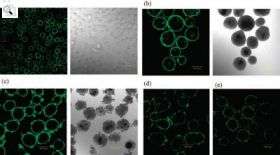
Scientists have developed a process that could could improve transplants of insulin-producing cells for treating diabetes. The new method prevents destruction of those cells by coating them with heparin. Courtesy of the American Chemical Society

Researchers in Japan are reporting a discovery that could improve the effectiveness and expand the use of transplants of insulin-producing cells to treat diabetes. Their study is scheduled for the July 16 issue of ACS' Bioconjugate Chemistry. Insulin-dependent, or Type 1, diabetes affects about 800,000 people in the United States.

In the new study, Yuji Teramura and Hiroo Iwata point out that transplantation of the pancreas's insulin producing cells, so-called islets of Langerhans, is a promising experimental technique for treating patients with insulin-dependent diabetes.

However, the procedure is not sufficiently effective for many people. This is because the body destroys many of the islet cells right after transplantation in an inflammatory reaction triggered by blood clotting on the surface of the cells, the researchers say.

To address this problem, the scientists coated islet cells with a special polymer film containing heparin, an anticoagulant, or urokinase, a medication that dissolves blood clots. In laboratory studies, the researchers showed that the coatings delayed the clotting long enough to prevent the destruction that otherwise would occur immediately after transplantation.

The coatings did not affect the ability of the cells to produce insulin, the researchers add.

Source: ACS

Explore further: Making ice-cream more nutritious with meat left-overs

add to favorites email to friend print save as pdf

Related Stories

Biomaterial shows promise for Type 1 diabetes treatment

May 09, 2013

(Phys.org) —Researchers have made a significant first step with newly engineered biomaterials for cell transplantation that could help lead to a possible cure for Type 1 diabetes, which affects about 3 ...

Microwave oven cooks up solar cell material

May 06, 2013

University of Utah metallurgists used an old microwave oven to produce a nanocrystal semiconductor rapidly using cheap, abundant and less toxic metals than other semiconductors. They hope it will be used ...

Recommended for you

Making ice-cream more nutritious with meat left-overs

4 hours ago

Food industries are now turning meat left-over into high-protein content ingredients for food supplements, or to be added to processed food. But a EU-wide regulation covering them is still lacking.

Non-wetting fabric drains sweat

20 hours ago

(Phys.org) —Waterproof fabrics that whisk away sweat could be the latest application of microfluidic technology developed by bioengineers at the University of California, Davis.

Protein study suggests drug side effects are inevitable

21 hours ago

A new study of both computer-created and natural proteins suggests that the number of unique pockets – sites where small molecule pharmaceutical compounds can bind to proteins – is surprisingly small, meaning drug side ...

Attacking MRSA with metals from antibacterial clays

May 17, 2013

In the race to protect society from infectious microbes, the bugs are outrunning us. The need for new therapeutic agents is acute, given the emergence of novel pathogens as well as old foes bearing heightened antibiotic resistance.

User comments : 0

More news stories

Protein study suggests drug side effects are inevitable

A new study of both computer-created and natural proteins suggests that the number of unique pockets – sites where small molecule pharmaceutical compounds can bind to proteins – is surprisingly small, meaning drug side ...

Non-wetting fabric drains sweat

(Phys.org) —Waterproof fabrics that whisk away sweat could be the latest application of microfluidic technology developed by bioengineers at the University of California, Davis.

Beautiful 'flowers' self-assemble in a beaker

By simply manipulating chemical gradients in a beaker of fluid, materials scientists at Harvard have found that they can control the growth behavior of crystals to create precisely tailored structures—such ...

Attacking MRSA with metals from antibacterial clays

In the race to protect society from infectious microbes, the bugs are outrunning us. The need for new therapeutic agents is acute, given the emergence of novel pathogens as well as old foes bearing heightened antibiotic resistance.

Game system castAR debuts at Maker Faire

(Phys.org) —Two tech talents, formerly employees at video game publisher Valve, have been working on their own vision in the form of game-ready glasses. Their company, Technical Illusions, will seek to ...

Glaucoma drug can cause droopy eyelids

Prostaglandin analogues (PGAs), drugs which lower intraocular pressure, are often the first line of treatment for people with glaucoma, but their use is not without risks. PGAs have long been associated with blurred vision, ...