Global warming affects world's largest freshwater lake
May 01, 2008
Global warming affects world's largest freshwater lake
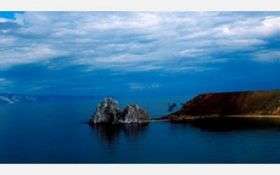
Shaman Rock on Russia's Lake Baikal stands guard over the world's largest freshwater lake. Credit: Nicholas Rodenhouse

Russian and American scientists have discovered that the rising temperature of the world's largest lake, located in frigid Siberia, shows that this region is responding strongly to global warming.

Drawing on 60 years of long-term studies of Russia's Lake Baikal, Stephanie Hampton, an ecologist and deputy director of the National Center for Ecological Analysis and Synthesis (NCEAS) in Santa Barbara, Calif., and Marianne Moore, a biologist at Wellesley College in Wellesley, Mass., along with four other scientists, report their results on-line today in the journal Global Change Biology.

"Warming of this isolated but enormous lake is a clear signal that climate change has affected even the most remote corners of our planet," Hampton said.

In their paper, the scientists detail the effects of climate change on Lake Baikal--from warming of its vast waters to reorganization of its microscopic food web.

"The conclusions shown here for this enormous body of freshwater result from careful and repeated sampling over six decades," said Henry Gholz, program director for NCEAS at the National Science Foundation (NSF), which funded the research. "Thanks to the dedication of local scientists, who were also keen observers, coupled with modern synthetic approaches, we can now visualize and appreciate the far-reaching changes occurring in this lake."

Lake Baikal is the grand dame of lakes. In 1996, the United Nations Educational, Scientific and Cultural Organization (UNESCO) declared it a World Heritage site because of its biological diversity. It boasts 2500 plant and animal species, with most, including the freshwater seal, found nowhere else in the world.

The lake contains 20 percent of the world's freshwater, and it is large enough to hold all the water in the United States' Great Lakes. It is the world's deepest lake as well as its oldest; at 25 million years old, it predates the emergence of humans.

In more recent times, it was a dedicated group of humans who made this study possible.

"Our research relies on a 60-year data set, collected in Lake Baikal by three generations of a single family of Siberian scientists," Moore said. "In the 1940s, Mikhail Kozhov began collecting and analyzing water samples in anticipation that this lake could reveal much about how lakes in general function.

"Ultimately, his daughter Olga Kozhova continued the program, followed by her daughter, who is also a co-author of today's paper: Lyubov Izmest'eva."

The decades-long research effort survived the reign of Stalin, the fall of the Soviet Union, and other social and financial upheavals in the region.

Data collection continued through every season, in an environment where winter temperatures drop to -50 degrees F.

The data on Lake Baikal reveal "significant warming of surface waters and long-term changes in the food web of the world's largest, most ancient lake," write the researchers in their paper. "Increases in water temperature (1.21°C since 1946), chlorophyll a (300 percent since 1979), and an influential group of zooplankton grazers (335 percent since 1946) have important implications for nutrient cycling and food web dynamics."

The scientists conclude that the lake now joins other large lakes, including Superior, Tanganyika and Tahoe, in showing warming trends.

"But," they note, "temperature changes in Lake Baikal are particularly significant as a signal of long-term regional warming.

"This lake was expected to be among those most resistant to climate change, due to its tremendous volume and unique water circulation."

Source: National Science Foundation

Explore further: Honeybees trained in Croatia to find land mines

add to favorites email to friend print save as pdf

Related Stories

Russia moves to shut down Lake Baikal paper mill

Feb 28, 2013

A controversial Soviet-era paper mill on the shores of Lake Baikal will be closed down, a government spokeswoman said Thursday, after years of complaints about pollution at the UNESCO-protected Siberian site.

Study shows best places to protect marine mammals

Aug 01, 2011

(AP) -- From sea otters to blue whales, marine mammals are under stress from climate change, ocean acidification, hunting and other threats. Researchers have identified 20 important sites around the world ...

Space race for Sochi 2014 flame

Jul 07, 2011

The Sochi 2014 Winter Olympics flame could be heading for space as part of the 120-day torch relay, organisers said on Thursday.

World's largest lake sheds light on climate change

Feb 17, 2011

(PhysOrg.com) -- Siberia's Lake Baikal, the world's oldest, deepest, and largest freshwater lake, has provided scientists with insight into the ways that climate change affects water temperature, which in ...

Recommended for you

Honeybees trained in Croatia to find land mines

9 hours ago

(AP)—Mirjana Filipovic is still haunted by the land mine blast that killed her boyfriend and blew off her left leg while on a fishing trip nearly a decade ago. It happened in a field that was supposedly ...

Front-row seats to climate change

May 17, 2013

By day, insects provide the white noise of the South, but the night belongs to the amphibians. In a typical year, the Southern air hangs heavy from the humidity and the sounds of wildlife.

Climate change may have little impact on tropical lizards

May 17, 2013

A new Dartmouth College study finds human-caused climate change may have little impact on many species of tropical lizards, contradicting a host of recent studies that predict their widespread extinction in a rapidly warming ...

Wetlands: value to locals matters most

May 17, 2013

A new way of valuing ecosystem services, incorporating the local perspective, is the driving force behind a project assessing aquatic ecosystems in highland areas of Asia

User comments : 10

Adjust slider to filter visible comments by rank

Display comments: newest first

MikeB
3.2 / 5 (6) May 01, 2008
I think it's interesting that no mention is made of the fact that the lake is located on a geologically active rift. There are hot springs associated with Lake Baikal. See the wikipedia article.
MikeB
3 / 5 (6) May 01, 2008
Here is a highlight:
Lake Baikal is in a rift valley created by the Baikal Rift Zone, where the crust of the earth is pulling apart... In geological terms, the rift is young and active, it widens about two centimeters per year. The fault zone is also seismically active: there are hot springs in the area and notable earthquakes every few years.
Minnaloushe
2.5 / 5 (8) May 01, 2008
It's also revealing that whenever this site mentions "global warming" it does so as if it is an undisputed fact -- not a very scientific thing to do. Say it enough times and it's true, huh?
thinking
2.3 / 5 (9) May 01, 2008
Lets see... the world temp has not risen in the last ten years or so..... and according to another article on physorg... no temperature increase is seen for the next 10 years.... If the temp of the lake would have dropped... they would have blamed global warming..... I have come to believe that global warming is a scam to suck money away from believers..... and from unbelievers (via taxes)...
p1ll
2.5 / 5 (8) May 01, 2008
global warming is the biggest scam in history. I have nothing else to say ;)
1bigschwantz
2 / 5 (5) May 01, 2008
Funny this is a Siberian lake....remember the big spike in global temp in the early 90's that the enviros love to point to as a warming alarm?
The reason is that after the soviet Union fell, the reporting stations in siberia fell into dis-repair. Since they are in the northern (thus colder) climes, this will cause the average temp to spike once they stop reporting their numbers. Of course, we're not supposed to know this.
mikiwud
1 / 5 (2) May 02, 2008
I have never seen any reference the the mid-oceanic ridge in any discussion.With 36,000ish miles of continuous volcanic action,it's got to have some effect on the ocean temperature and CO2,as the rift could on lake Baikal.But,is it variable?
MikeB
2.8 / 5 (5) May 02, 2008
USGS tracks volcanic variability. USGS, science for a CHANGING world. That is their tagline. Climate is variable too. It always has been. We need to get used to it.
COCO
1 / 5 (3) May 05, 2008
OMG - 60 whole years of data - that is an immense amount of geological info - try and edit these types of political Gorisms please - remember the Prof who cried wolf!
lengould100
not rated yet Jul 22, 2008
If you're rowing a boat across it, do you care about the size of the lake by volume or by area? Baikal is only the 7th largest lake by area, barely larger than Great Bear. Sheesh.

1) Superior, U.S.-Canada 31,820 82,414 383 616 1,333 406
2) Victoria, Tanzania-Uganda 26,828 69,485 200 322 270 82
3) Huron, U.S.-Canada 23,010 59,596 247 397 750 229
4) Michigan, U.S. 22,400 58,016 321 517 923 281
5) Aral, Kazakhstan-Uzbekistan 13,000 33,800 266 428 223 68
6) Tanganyika, Tanzania-Congo 12,700 32,893 420 676 4,708 1,435
7) Baikal, Russia 12,162 31,500 395 636 5,712 1,741
8) Great Bear, Canada 12,000 31,080 232 373 270 82

More news stories

Honeybees trained in Croatia to find land mines

(AP)—Mirjana Filipovic is still haunted by the land mine blast that killed her boyfriend and blew off her left leg while on a fishing trip nearly a decade ago. It happened in a field that was supposedly ...

Heat-related deaths in Manhattan projected to rise

Residents of Manhattan will not just sweat harder from rising temperatures in the future, says a new study; many may die. Researchers say deaths linked to warming climate may rise some 20 percent by the 2020s, ...

Kinks and curves at the nanoscale

One of the basic principles of nanotechnology is that when you make things extremely small—one nanometer is about five atoms wide, 100,000 times smaller than the diameter of a human hair—they are going ...