Scientists fine-tuning methods for Stardust analysis
March 22, 2006

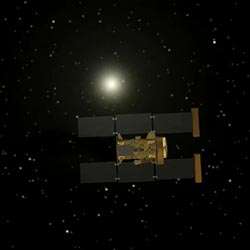
Artist concept of Stardust.

Artist concept of Stardust.

On Sunday, January 15, NASA's Stardust mission landed safely with the first solid comet fragments ever brought back to Earth. Members of the mission's Preliminary Examination Team, including several from the Carnegie Institution's Geophysical Laboratory and Department of Terrestrial Magnetism, are among the first to analyze these precious samples. The researchers are refining methods to zero in on organic molecules--the ingredients of life--contained in the grains captured from the coma of comet Wild-2.

The team is already generating preliminary data.

Scientists believe comets like Wild-2 are the oldest solid bodies in the solar system. Yet until now, no one has seen a piece of a comet up close. Researchers expect to retrieve less than one thousandth of an ounce of material from Stardust's collection grid, but this tiny puff of dust might yield scientific gold: by comparing the structure and chemistry of Stardust grains to interstellar dust and rare meteorites rich in organic material, researchers hope to fill in some significant holes in what we know about the evolution and history of our solar system.

"It is likely that some of the carbon in our bodies was originally bound up in comets and delivered to the early Earth through impacts," explained Marc Fries of Carnegie's Geophysical Laboratory, a member of the Preliminary Examination Team. "So when we say that 'we are stardust' we are literally talking about the type of material that Stardust has returned to our laboratories for analysis."

Carnegie's researchers are studying their first Stardust sample with a brand new, $2.8 million NanoSIMS ion probe. This instrument can reveal the chemical makeup of a sample by vaporizing tiny target areas with a stream of ions, allowing an accurate count of the atoms emitted; the NanoSIMS is an ideal tool for analyzing minuscule Stardust grains because it has greater sensitivity than previous ion probes.

The team also plans to study the physical and chemical details of Stardust grains using two different spectroscopic techniques. First, by analyzing laser light reflected from a sample, Raman spectroscopy can reveal both the structure of minerals and the forms of carbon present. Second, a unique soft X-ray microscope at Lawrence Berkeley National Laboratory's Advanced Light Source facility in California enables a technique called XANES spectroscopy, which can help characterize the carbon, nitrogen, and oxygen species in organic matter. Since the carbon-containing materials from Wild-2 are likely to be little changed since the birth of the solar system, these analyses are especially important.

Carnegie researchers from the Geophysical Laboratory and the Department of Terrestrial Magnetism will discuss the analysis of interstellar matter, including early isotopic and spectroscopic results from Stardust, in several talks and posters at the NASA Astrobiology Science Conference (AbSciCon) 2006 at the Ronald Reagan Building in Washington, D.C. March 26-30.

Source: Carnegie Institution

4.7 /5 (3 votes)  

Rank 4.7 /5 (3 votes)
Tags

Relevant PhysicsForums posts

More news stories

Land and sea species differ in climate change response: study

(Phys.org) -- Marine and terrestrial species will likely differ in their responses to climate warming, new research by Simon Fraser University and Australia’s University of Tasmania has found.

Space & Earth / Environment

created 6 hours ago | popularity 3.8 / 5 (4) | comments 5 | with audio podcast

Yale study concludes public apathy over climate change unrelated to science literacy

Are members of the public divided about climate change because they don't understand the science behind it? If Americans knew more basic science and were more proficient in technical reasoning, would public consensus match ...

Space & Earth / Environment

created 8 hours ago | popularity 4.8 / 5 (5) | comments 20 | with audio podcast

10 million years needed to recover from mass extinction

It took some 10 million years for Earth to recover from the greatest mass extinction of all time, latest research has revealed.

Space & Earth / Earth Sciences

created 8 hours ago | popularity 4 / 5 (4) | comments 1 | with audio podcast

Sophisticated simulations predict future warming

The chances of our planet being hit by a global warming of 3 degrees Celsius by 2050 is as likely as it being hit by an increase of 1.4 degrees, new research shows. Presented in the journal Nature Geoscience, the British study ...

Space & Earth / Earth Sciences

created May 22, 2012 | popularity 3.8 / 5 (11) | comments 51

Aliens don't want to eat us, says former SETI director

Alien life probably isn’t interested in having us for dinner, enslaving us or laying eggs in our bellies, according to a recent statement by former SETI director Jill Tarter.

Space & Earth / Space Exploration

created May 25, 2012 | popularity 4.4 / 5 (15) | comments 41


Stunning image of smallest possible five-ringed structure

Scientists have created and imaged the smallest possible five-ringed structure – about 100,000 times thinner than a human hair – and you'll probably recognise its shape.

'Unzipped' carbon nanotubes could help energize fuel cells, batteries

Multi-walled carbon nanotubes riddled with defects and impurities on the outside could replace some of the expensive platinum catalysts used in fuel cells and metal-air batteries, according to scientists at ...

Change in developmental timing was crucial in the evolutionary shift from dinosaurs to birds: study

At first glance, it's hard to see how a common house sparrow and a Tyrannosaurus Rex might have anything in common. After all, one is a bird that weighs less than an ounce, and the other is a dinosaur that ...

Computer model used to pinpoint prime materials for efficient carbon capture

When power plants begin capturing their carbon emissions to reduce greenhouse gases – and to most in the electric power industry, it's a question of when, not if – it will be an expensive undertaking.

T cells 'hunt' parasites like animal predators seek prey, study shows

By pairing an intimate knowledge of immune-system function with a deep understanding of statistical physics, a cross-disciplinary team at the University of Pennsylvania has arrived at a surprising finding: T cells use a movement ...

Scientists develop ultra-sensitive test that detects diseases in their earliest stages

Scientists have developed an ultra-sensitive test that should enable them to detect signs of a disease in its earliest stages, in research published today in the journal Nature Materials.