Toward a Rosetta Stone for Microbes' Secret Language
Dec 10, 2007
Toward a Rosetta Stone for Microbes’ Secret Language
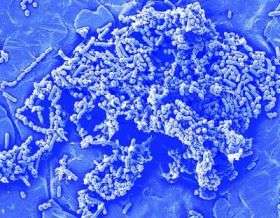
Decoding the chemical language of bacteria will help researchers fight antibiotic-resistant infections and dangerous biofilms (shown) that foul medical implants. Credit: USDA

Scientists are on the verge of decoding the special chemical language that bacteria use to “talk” to each other, British researchers report in a commentary article that appeared in the November issue of ACS Chemical Biology, a monthly journal. That achievement could lead to new treatments for antibiotic-resistant bacteria, including so-called superbugs that infect more than 90,000 people in the United States each year, they note.

David Spring, Martin Welch, and James T. Hodgkinson explain that researchers long have known that bacteria communicate with each other. Microbes release small molecules that enable millions of individuals in a population to coordinate their behavior.

Disease-causing bacteria use this language to decide when to infect a person or other host. Decoding the structure and function of compounds involved in this elaborate signaling process, known as “quorum sensing,” could lead to new medicines to block the signals and prevent infections.

The report describes development of a group of powerful compounds, called N-acylated homoserine lactone (AHL) analogues that are effective against a broad-range of bacterial types, including those that cause diseases in humans. These compounds are “some of the most potent synthetic modulators of quorum sensing” identified to date, they say.

In addition to showing promise for fighting antibiotic-resistant infections, the compounds may help prevent the growth of biofilms that foul medical implants and cause tooth decay and gum disease, the scientists note.

Source: American Chemical Society

Explore further: Long distance calls by sugar molecules

add to favorites email to friend print save as pdf

Related Stories

Nematodes encapsulated to better battle corn pests

Jun 07, 2013

Each spring, the western corn rootworm (Diabrotica virgifera) awakens from its winter slumber to wreak havoc on corn crops across the United States. The pest emerges in larval form, hatching from small white ...

Chemists find new compounds to curb staph infection

May 23, 2013

(Phys.org) —In an age when microbial pathogens are growing increasingly resistant to the conventional antibiotics used to tamp down infection, a team of Wisconsin scientists has synthesized a potent new ...

Recommended for you

Long distance calls by sugar molecules

11 hours ago

All our cells wear a coat of sugar molecules, so-called glycans. ETH Zurich and Empa researchers have now discovered that glycans rearrange water molecules over long distances. This may have an effect on ...

Counting small RNA in disease-causing organisms

17 hours ago

Small molecules of RNA (tens to hundreds of nucleotides in length) play a key regulatory role in bacteria. Due to their small size, directly measuring the number of small RNA (sRNA) present in a single bacterium ...

User comments : 0

More news stories

Long distance calls by sugar molecules

All our cells wear a coat of sugar molecules, so-called glycans. ETH Zurich and Empa researchers have now discovered that glycans rearrange water molecules over long distances. This may have an effect on ...

Counting small RNA in disease-causing organisms

Small molecules of RNA (tens to hundreds of nucleotides in length) play a key regulatory role in bacteria. Due to their small size, directly measuring the number of small RNA (sRNA) present in a single bacterium ...

3D printing tiny batteries

(Phys.org) —3D printing can now be used to print lithium-ion microbatteries the size of a grain of sand. The printed microbatteries could supply electricity to tiny devices in fields from medicine to communications, ...