Solving another mystery of an amazing water walker
Dec 10, 2007
Solving another mystery of an amazing water walker
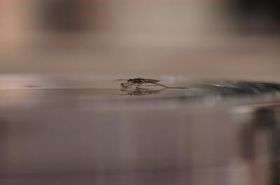
Scientists have found a new explanation for the water strider's "miraculous" ability to lead onto a liquid surface without sinking. Credit: Ho-Young Kim, Seoul National University, Korea

Walking on water may seem like a miracle to humans, but it is a ho-hum for the water strider and scientists who already solved the mystery of that amazing ability. Now researchers in Korea are reporting a long-sought explanation for the water strider’s baffling ability to leap onto a liquid surface without sinking. The study is scheduled for the Dec. 18 issue of ACS’ Langmuir.

In the new study, Ho-Young Kim and Duck-Gyu Lee note that scientists already have discovered the hydrophobic, or water-repellent, structure of the water strider’s legs and how they allowed the creatures to scoot along ponds and placid lakes. However, their ability to jump onto or “bounce” off liquid surfaces remained a lingering scientific mystery.

Kim and Lee solved it by dropping a highly water-repellent sphere onto the surface of water at different speeds, carefully tracking its motion with high-speed cameras. They found that the ball must be traveling within a narrow velocity range in order to bounce off the water’s surface. The sphere may sink if it goes too fast and won’t bounce back if too slow.

“The highly improved ability of heavy hydrophobic solids to keep afloat on water even after impacting upon water with a high velocity appears to explain partially why water striders have superhydrophobic legs,” say the authors. “Application of our study can be extended to developing semi-aquatic robots that mimic such insects having the surprising mobility on water.”

Source: American Chemical Society

Explore further: Attacking MRSA with metals from antibacterial clays

add to favorites email to friend print save as pdf

Related Stories

Bacteria adapt and evade nanosilver's sting

May 08, 2013

(Phys.org) —Researchers from UNSW have cautioned that more work is needed to understand how micro-organisms respond to the disinfecting properties of silver nano-particles, increasingly used in consumer ...

Wind and cold carry dust to new heights

May 06, 2013

(Phys.org) —Scientists at China's Lanzhou University and Pacific Northwest National Laboratory found that dust lifted from the Taklimakan Desert during a dust storm had a significant effect on the regional ...

Landsat thermal sensor lights up from volcano's heat

May 06, 2013

As the Landsat Data Continuity Mission satellite flew over Indonesia's Flores Sea April 29, it captured an image of Paluweh volcano spewing ash into the air. The satellite's Operational Land Imager detected ...

Recommended for you

Attacking MRSA with metals from antibacterial clays

May 17, 2013

In the race to protect society from infectious microbes, the bugs are outrunning us. The need for new therapeutic agents is acute, given the emergence of novel pathogens as well as old foes bearing heightened antibiotic resistance.

Beautiful 'flowers' self-assemble in a beaker

May 16, 2013

By simply manipulating chemical gradients in a beaker of fluid, materials scientists at Harvard have found that they can control the growth behavior of crystals to create precisely tailored structures—such ...

Reading the unreadable

May 16, 2013

Pioneering X-ray technology is making it possible to read fragile rolled-up historical documents for the first time in centuries.

User comments : 0

More news stories

Attacking MRSA with metals from antibacterial clays

In the race to protect society from infectious microbes, the bugs are outrunning us. The need for new therapeutic agents is acute, given the emergence of novel pathogens as well as old foes bearing heightened antibiotic resistance.

Beautiful 'flowers' self-assemble in a beaker

By simply manipulating chemical gradients in a beaker of fluid, materials scientists at Harvard have found that they can control the growth behavior of crystals to create precisely tailored structures—such ...

Honeybees trained in Croatia to find land mines

(AP)—Mirjana Filipovic is still haunted by the land mine blast that killed her boyfriend and blew off her left leg while on a fishing trip nearly a decade ago. It happened in a field that was supposedly ...

Mice, gerbils perish in Russia space flight

A number of mice and eight gerbils sent into space in a Russian capsule destined to find out how well organisms can withstand extended flights perished during their journey, scientists said Sunday as the ...

Bold action, big money needed to curb Asia floods

Asia's flood-prone megacities should fund major drainage, water recycling and waste reduction projects to stem deluges and secure clean supply for their booming populations, experts said Sunday.