Researchers find ways heat-loving microbes create energy
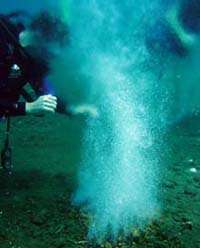
Curiosity about the microbial world drove Jan Amend, Ph.D., associate professor of earth and planetary sciences in Arts & Sciences at Washington University in St. Louis, to Vulcano Island, Italy, a shallow hydrothermal Shangri-la near Sicily. There, Amend and his collaborators managed to examine the environment in depth, design a gene probe, and discover new life – which could have some big implications for the origin and presence of life on Earth.
A diverse microbial community busies itself on the rough side of the oxic-anoxic interface – the place where cool, oxygenated, near-surface seawater mixes with oxygen-poor, ultra-hot hydrothermal fluid. That community is less than a meter below the water's surface, but these populations living in shallow hydrothermal coastal systems around the world are poorly understood. Studying shallow hydrothermal systems doesn't seem as glamorous as navigating the depths of the sea to research ocean-floor geysers, following the belches of black smokers or white smokers or chimneys; instead, Amend traded his SCUBA suit for a trowel to do some old-fashioned beach digging. What he came up with is discussed in a recent issue of Chemical Geology.
Gaining energy from various reactions
Amend's group has shown that hundreds of potential metabolic reactions are energy- yielding in the Vulcano hydrothermal system, but only a few of them have been shown in laboratory studies to be used by the resident organisms – the group doesn't know why.
Thermodynamic calculations show that energy can be obtained from a vast array of organic and inorganic reactions. Members of at least 10 hyperthermophilic genera call Vulcano home. And gene surveys -- using 16S rRNA gene -- have now shown that many uncultured archaea are present in the Vulcano hydrothermal system.
"We used gene probes -- a technique called FISH for fluorescent in situ hybridization -- to determine the percentages of key groups of bacteria and archaea in the Vulcano sediments, " Amend said. "It is nice to know who is there, but the next step is to know how many are there , which is what we did, and what they are doing . These are functional gene studies, which we have not done yet."
Results of the Amend group study show that:
-- organic compounds did not accumulate in the vent fluids or the sediments, suggesting that the microbial community utilized them for energy/carbon.
-- groups of thermophiles (including Thermococcales, Thermotoga, Bacillus) that typically gain energy by fermenting organic matter were detected by FISH in significant numbers.
-- thermophiles capable of oxidizing -- as opposed to fermenting -- organic matter with oxygen, nitrate, or sulfate also were abundant.
-- as expected, aerobic thermophiles -- less numerous than their anaerobic counterparts -- were more abundant at oxic sites than at anoxic sites.
Hydrothermal organisms do things differently: They take advantage of the kinds of chemical abundances our own bodies shun. All living things perform redox reactions, whereby organisms take advantage of conditions leading to chemical disequilibrium, providing energy for a reaction.
When we metabolize, we combine oxygen with the sugars and fats we eat to make carbon dioxide and water. The reaction releases energy and restores chemical equilibrium. Vulcano's hydrothermal communities take a slightly different approach to metabolism.
Twinkies vs. hydrogen
"These microbes convert a wide variety of compounds to release energy," Amend explained. "One of the most common energy sources for these very high-temperature organisms is actually in the sulfur system. Where we use oxygen, they use elemental sulfur. Where we use bran muffins, and sugar and twinkies and snickers, they use hydrogen."
The energy source for microbial processes isn't from the sun–it's from chemical mixing. Fluids from hydrothermal vents below the surface are slightly hotter, more acidic, and more chemically reduced (electrons-rich) than the surrounding seawater and atmosphere. Vent fluid mixes with cool, alkaline, slightly oxidized (electron-poor) seawater and voila! The chemical instability of the two distinct fluids becomes a source of energy.
By studying the redox processes -- like metabolisms -- of these heat-loving microorganisms, Amend and his team could understand and describe their understudied environments.
"We did find that the microbial community in the oxic layers tends to be dominated by microbes that are believed to be using oxygen -- in redox -- like you or I do," Amend said. "As you get into the subsurface where oxygen disappears, the organisms that you find there rely more and more on processes that use compounds other than oxygen as their oxidant."
Clues to origins of life
Why go to all this trouble for something most of us will never see? As it happens, these organisms, invisible to the naked eye, hold big clues to the origin of life on Earth.
"Most people involved in the origin of life, including myself, would argue that the most likely 'last common ancestor' was in a high-temperature environment.," Amend says.
The so-called last common ancestor is the link between two main types of organisms: prokaryotic organisms called archea and bacteria whose cells contain a membraneless nucleus, eukaryotes, whose cells have a membrane-bound nucleus. The deepest branching bacteria and archea on the "tree of life," which traces the genetic relationships between very primitive organisms through their trait development, are high-temperature organisms. And they carry out chemical processes that suggest a high-temperature origin of life.
The results aren't as conclusive as they seem. A reality is that most microbial organisms have not been cultured. In order for researchers like Amend to maximize their findings, and to determine what the microbes' relations to each other and to the last common ancestor are, the data set needs to increase.
"We've isolated and at least partially characterized several hundred high-temperature organisms. There's no telling how many more there are–we haven't even scratched the surface."
Amend said that shallow marine hydrothermal sites are great natural laboratories to study the roles of thermophiles in mediating geochemical processes, especially electron transfer – redox -- processes.
"Marine hydrothermal sites are compositionally highly diverse, microbially highly diverse, relatively easy to study -- compared with their deep-sea cousins -- and the spaghetti alla vongole (clams) in Sicily is out of this world," Amend said of his research and his favorite locale.
Source: Washington University in St. Louis, By Alison Drain


