Crystal structure library gets a 'data lift'
Mar 06, 2006
Crystal structure library gets a 'data lift'
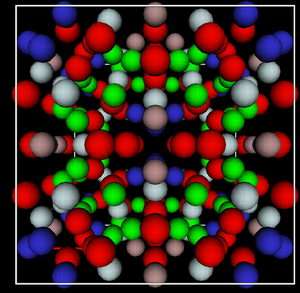
Image credit: NIST

Much of science these days depends on "black (or beige) boxes," scientific instruments that invisibly analyze data and then, voilá, identify the chemistry and/or structure of a sample. While scientists and engineers may be glad that the data crunching is invisible, the quality of the data used is critically important to something that they do care deeply about--getting an accurate answer.

Through two years of meticulous evaluation studies, the National Institute of Standards and Technology (NIST) has helped ensure that "black boxes" that identify crystal structures will have the best possible data. The NIST Structural Database is a compilation of chemical data and three-dimensional crystal structures for approximately 20,000 materials, primarily metals, alloys and intermetallics. (Intermetallic materials are compounds of two or more metals with mechanical properties often resembling a cross between metals and ceramics.)

While the database has been available previously, this latest upgrade features a re-evaluation of all 20,000 crystal structures to ensure that the highest quality data are included. The upgrade efforts include improved standardization of the data provided for each structure and additional data fields for each entry. The structure data provided can be imported into Virtual Reality Modeling Language (VRML) players that allow researchers to view the structures in three dimensions and to rotate them in space.

The database is typically licensed by software companies and instrument manufacturers. For example, the database may be incorporated into software used to identify chemical compositions and/or crystalline structures using electron diffraction. Diffraction instruments work by aiming a beam of radiation (such as X-rays, electrons, neutrons, etc.) at a sample and then analyzing the resulting scattering patterns produced.

Source: NIST

Explore further: As chaos celebrates its 50th birthday, biophysicist develops a new method to visualize it

add to favorites email to friend print save as pdf

Related Stories

Kinks and curves at the nanoscale

May 19, 2013

One of the basic principles of nanotechnology is that when you make things extremely small—one nanometer is about five atoms wide, 100,000 times smaller than the diameter of a human hair—they are going ...

Beautiful 'flowers' self-assemble in a beaker

May 16, 2013

By simply manipulating chemical gradients in a beaker of fluid, materials scientists at Harvard have found that they can control the growth behavior of crystals to create precisely tailored structures—such ...

Recommended for you

A quantum simulator for magnetic materials

6 hours ago

Physicists understand perfectly well why a fridge magnet sticks to certain metallic surfaces. But there are more exotic forms of magnetism whose properties remain unclear, despite decades of intense research. ...

Engineers pioneer flat spray-on optical lens

10 hours ago

A University of British Columbia engineer and a team of U.S. researchers have made a breakthrough utilizing spray-on technology that could revolutionize the way optical lenses are made and used.

Researchers forward quest for quantum computing

12 hours ago

Research teams from UW-Milwaukee and the University of York investigating the properties of ultra-thin films of new materials are helping bring quantum computing one step closer to reality.

How do cold ions slide

12 hours ago

Things not always run smoothly. It may happen, actually, that when an object slides on another, the advancement may occur through a 'stop and go' series in the characteristic manner which scientists call ...

User comments : 0

More news stories

A quantum simulator for magnetic materials

Physicists understand perfectly well why a fridge magnet sticks to certain metallic surfaces. But there are more exotic forms of magnetism whose properties remain unclear, despite decades of intense research. ...

Engineers pioneer flat spray-on optical lens

A University of British Columbia engineer and a team of U.S. researchers have made a breakthrough utilizing spray-on technology that could revolutionize the way optical lenses are made and used.

Researchers forward quest for quantum computing

Research teams from UW-Milwaukee and the University of York investigating the properties of ultra-thin films of new materials are helping bring quantum computing one step closer to reality.

How do cold ions slide

Things not always run smoothly. It may happen, actually, that when an object slides on another, the advancement may occur through a 'stop and go' series in the characteristic manner which scientists call ...

Controlling mood through the motions of mitochondria

(Medical Xpress)—Regulating the distribution of power in neurons is done by a system that makes the national electric grid look simple by comparison. Each neuron has several thousand mitochondria confined ...