Speed plays crucial role in breaking protein's H-bonds
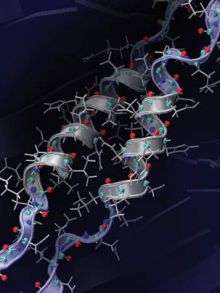
Researchers at MIT studying the architecture of proteins have finally explained why computer models of proteins' behavior under mechanical duress differ dramatically from experimental observations. This work could have vast implications in bioengineering and medical research by advancing our understanding of the relationship between structure and function in these basic building blocks of life.
In a paper published as the cover article of the Oct. 16 issue of the Proceedings of the National Academies of Science, the scientists, who work with atomistic models--accurate representations of nature that use fundamental laws of atomistic interactions as their basis--show for the first time the basic rupture mechanisms of protein structures when protein strands unfold in response to pressure.
"We have for the first time simulated the behavior of protein structures under conditions that correspond to those in living biological systems," said Markus Buehler, the Esther and Harold E. Edgerton Assistant Professor in MIT's Department of Civil and Environmental Engineering and lead researcher on the team. "All the different types of proteins we studied exhibit two distinct fracture modes that are dependent on the speed at which force is applied. Now we understand that what seemed unrealistic in the earlier computer simulations was actually a consequence of deformation rates and a change in the way hydrogen bonds respond to pressure."
Researchers had puzzled over the vast difference in the amount of pressure required to unfold proteins in experimental versus computer simulation. Earlier computer models forced researchers to apply force at much faster speeds than are possible in the laboratory. As a result, these earlier models predicted that the hydrogen bonds would rupture in response to pressures so small that proteins would be unstable. This clearly isn't the case. Rather, proteins form the structural basis of most biological materials.
It wasn't until the team, using large-scale computing facilities, was able to slow down the application of pressure in their models by a factor of 10 or 20 that they understood the discrepancy. At those speeds, which are much closer to the speeds at which pressure is applied in living cells and tissues, their study showed a change in behavior of the hydrogen bonds.
Explaining the puzzling phenomenon
Buehler and undergraduate student Xuefeng Chen, graduate student Sinan Keten, and Theodor Ackbarow, a graduate student from the University of Stuttgart working in Buehler's lab at MIT, set up a six-month computer simulation study. They worked with two different types of common proteins: vimentin--an alpha-helical filament protein that plays an important role in cellular signaling and stability--and amyloidal fibrils--beta-folded proteins. These protein motifs form the basis of many natural materials, such as hair, hoof, wool, spider silk and the prions that build up in the brains of Alzheimer's patients.
Hydrogen bonds are the basic chemical bonds that hold together proteins, similar to trusses and beams in buildings, and play a key role in controlling the behavior of these structures.
The researchers placed strain on the proteins by pulling on the ends, trying different pressures applied at different rates. They found that the hydrogen bonds in both the alpha-helical-type vimentin proteins and the beta-fibril-type amyloids behaved similarly. At higher rates, hydrogen bonds began to break apart one at a time, earlier in the process. When the pressure was applied more slowly, the bonds held out longer, but when they finally broke, they went three at a time.
"The slow deformation rate in proteins is most relevant in normal biological function, but the fast rate could be important during tissue injuries such as the shock impact in accidents and during formation of fractures in biological tissues," said -Buehler.
This work adds an important piece of knowledge to engineers' understanding of how organic materials work efficiently and provides important insight into how a protein's structure defines its unique mechanical properties. They showed that in order to enhance a protein's mechanical strength, the strands of amino acids should fold so that three or four parallel hydrogen bonds form at each convolution of the protein. Experimental evidence shows that proteins actually do fold so that hydrogen bonds form at the rate of 3.6 bonds per convolution.
In addition to enhanced strength, the protein's geometry also leads to a highly robust structure that provides it with an 80 percent "robustness rate," giving it very high marks from an engineering perspective. (A 100 percent rating could be applied only to a fail-safe structure.) "This 80 percent level of robustness, while simultaneously providing significant mechanical strength, enables the biological structure to minimize the use of materials and make it efficient overall and able to sustain extreme mechanical conditions," said the authors.
By contrast, the lack of robustness in many synthetic materials makes it necessary for engineers to introduce large safety factors that guarantee a structure's functionality under extreme conditions. "For instance, an engineering structure such as a tall building must be able to withstand loads that are 10 times greater than usual, just to protect it in case of one tiny crack," said Buehler. "By studying biological building materials and using a bottom-up structural design and synthesis approach, we hope to discover new ways to create stronger synthetic materials," he said.
"This new understanding could lead to the development of stronger, more robust materials that consume less energy in their manufacturing and transport. Such advances are only possible by including the molecular scale into the engineering design approach," said Buehler.
This work was funded by a National Science Foundation CAREER award, a grant from the Army Research Office, and an MIT Presidential Graduate Fellowship.
Source: MIT


