A faster, more sensitive method for detecting anthrax
Nov 05, 2007
Anthrax
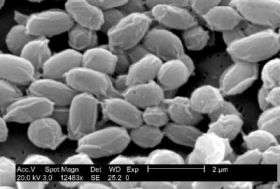
Anthrax spores as photographed under an electron microscope. Credit: Courtesy of Centers for Disease Control and Prevention

Amid continuing concerns that anthrax might be used as a bioterrorism weapon, government researchers report development of a faster, more sensitive blood test for detecting the deadly toxins produced by the anthrax bacterium, Bacillus anthracis. The test produces results in only 4 hours and could save lives by allowing earlier detection of infection, they say.

Their study is scheduled for publication in the Nov. 22 issue of ACS’ Analytical Chemistry, a semi-monthly journal.

Standard identification of anthrax (Bacillus anthracis) infection relies on a combination of time-consuming steps, including cell culture and gene amplification, which can take several days to provide a diagnosis and have limitations for detecting early stages of infection. Early diagnosis is critical for effective treatment of pulmonary or inhalation anthrax, the most deadly form.

John R. Barr and colleagues in a multi-center team effort used a form of mass spectrometry to detect the presence of ‘lethal factor,’ the key toxin produced by the anthrax bug, in the blood of monkeys with inhalation anthrax. The method took only four hours to identify the toxin and detected it at very low levels, demonstrating its potential for early detection of infection, the researchers say.

The new method also shows promise as a research tool for providing a better understanding of the anthrax infection cycle and for evaluating the effectiveness of different therapies and methods to fight infections.

Source: ACS

Explore further: Working backward: Computer-aided design of zeolite templates

add to favorites email to friend print save as pdf

Related Stories

This breathalyzer reveals signs of disease (w/ Video)

May 08, 2012

(Phys.org) -- This invention could give new meaning to the term "bad breath!" It's the Single Breath Disease Diagnostics Breathalyzer, and when you blow into it, you get tested for a biomarker—a sign ...

Researchers reveal SBP8a configurations

Dec 06, 2011

A new study has shown previously unseen details of an anthrax bacteriophage — a virus that infects anthrax bacteria — revealing for the first time how it infects its host, and providing an initial blueprint for ...

Nano detector for deadly anthrax

Jul 06, 2011

An automatic and portable detector that takes just fifteen minutes to analyze a sample suspected of contamination with anthrax is being developed by US researchers. The technology amplifies any anthrax DNA present in the ...

Recommended for you

Long distance calls by sugar molecules

7 hours ago

All our cells wear a coat of sugar molecules, so-called glycans. ETH Zurich and Empa researchers have now discovered that glycans rearrange water molecules over long distances. This may have an effect on ...

Counting small RNA in disease-causing organisms

13 hours ago

Small molecules of RNA (tens to hundreds of nucleotides in length) play a key regulatory role in bacteria. Due to their small size, directly measuring the number of small RNA (sRNA) present in a single bacterium ...

User comments : 0

More news stories

Long distance calls by sugar molecules

All our cells wear a coat of sugar molecules, so-called glycans. ETH Zurich and Empa researchers have now discovered that glycans rearrange water molecules over long distances. This may have an effect on ...

Counting small RNA in disease-causing organisms

Small molecules of RNA (tens to hundreds of nucleotides in length) play a key regulatory role in bacteria. Due to their small size, directly measuring the number of small RNA (sRNA) present in a single bacterium ...

3D printing tiny batteries

(Phys.org) —3D printing can now be used to print lithium-ion microbatteries the size of a grain of sand. The printed microbatteries could supply electricity to tiny devices in fields from medicine to communications, ...