Israeli Scientist Invents Bomb Detector Spray
Oct 30, 2007 by Lisa Zyga weblog
Urea Nitrate Test
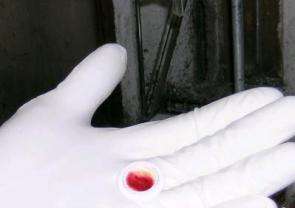
A cotton swab, sprayed with a color-changing chemical, will turn red after contact with urea nitrate. (Almog)

Professor Joseph Almog has developed a spray that can detect urea nitrate, a powerful explosive that can be created by non-professionals in relatively simple back-yard facilities. Urea nitrate is commonly used by Palestinian terrorists in Israel, as well as in suicide bombers' belts and in the 1993 World Trade Center bombing in New York.

Although urea nitrate is a colorless crystalline substance that is similar in appearance to sugar, Almog has developed a chemical color test, where a suspect´s hands are wiped with treated cotton, which will then turn bright red if the individual had recently touched urea nitrate. The test is based on the formation of a red dye in the chemical reaction between the chemical p-dimethylaminocinnamaldehyde and urea nitrate under neutral conditions.

Almog and research student Nitay Lemberger, who are from Hebrew University´s Casali Institute of Applied Chemistry in Jerusalem, have added the bomb detector test to an arsenal of other forensics tests. Almog, a former Israeli Police Brigadier General and Director of the Identification and Forensic Science Division of the Israeli Police, has done previous research on color changing test fluids.

His inventions include Ferrotrace, a chemical that turns dark violet when sprayed on hands that have recently held a pistol or grenade, an agent that reveals hidden fingerprints, as well as a kit that can identify a wide variety of explosives.

While other methods exist to detect urea nitrate, the spray is much simpler and less expensive, and has the potential to be widely used. Another advantage is that the spray can detect minute traces of the explosive not only on hands, but also on door handles, luggage containers and vehicles. The chemical can also distinguish with a high level of accuracy between sugar or other similar white powders and urea nitrate.

More information: Casali Institute of Applied Chemistry, Hebrew University Press Release

Explore further: Explainer: What are chemical weapons?

add to favorites email to friend print save as pdf

Related Stories

A urine based 'potion' can act as a CO2 absorbent (w/ Video)

Aug 17, 2012

The ocean, the ground, rocks and trees act as carbon drains but are far from places where greenhouses gases are concentrated, especially CO2. A Spanish researcher has proposed human, agricultural and livestock waste, suc ...

Recommended for you

Explainer: What are chemical weapons?

17 hours ago

There was chaos on the streets of Halajba in March 1988. In this corner of Iraq, at the time Iraqi Kurdistan, people had suddenly started experiencing cold-like symptoms – tight chest and nasal congestion. ...

Scientists develop advanced biological computer

18 hours ago

(Phys.org) —Using only biomolecules (such as DNA and enzymes), scientists at the Technion-Israel Institute of Technology have developed and constructed an advanced biological transducer, a computing machine capable of manipulating ...

Research aims to fix long-held, inaccurate insect model

18 hours ago

(Phys.org) —In humans, a polymer called melanin determines skin, eye and hair color—the darker the skin, the more melanin in a person's body. For insects, melanin is a major aspect of their immune defense ...

Molecular modelling to help create better, safer drugs

19 hours ago

(Phys.org) —How our bodies break down the common drugs ibuprofen, diclofenac and warfarin is the subject of a new study from the University of Bristol, published in the Journal of the American Chemical So ...

User comments : 0

More news stories

Scientists develop advanced biological computer

(Phys.org) —Using only biomolecules (such as DNA and enzymes), scientists at the Technion-Israel Institute of Technology have developed and constructed an advanced biological transducer, a computing machine capable of manipulating ...

Galaxies fed by funnels of fuel

(Phys.org) —Computer simulations of galaxies growing over billions of years have revealed a likely scenario for how they feed: a cosmic version of swirly straws.