Scientists see inside rocks in 3D, implications for finding life on Mars
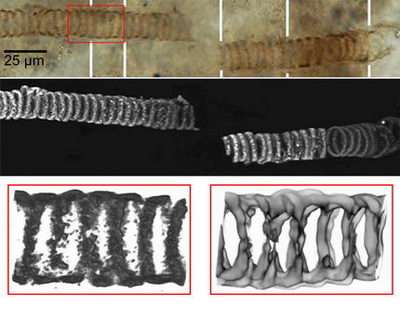
UCLA paleobiologist J. William Schopf and colleagues have produced 3-D images of ancient fossils -- 650 million to 850 million years old -- preserved in rocks, an achievement that has never been done before.
If a future space mission to Mars brings rocks back to Earth, Schopf said the techniques he has used, called confocal laser scanning microscopy and Raman spectroscopy, could enable scientists to look at microscopic fossils inside the rocks to search for signs of life, such as organic cell walls. These techniques would not destroy the rocks.
"It's astounding to see an organically preserved, microscopic fossil inside a rock and see these microscopic fossils in three dimensions," said Schopf, who is also a geologist, microbiologist and organic geochemist. "It's very difficult to get any insight about the biochemistry of organisms that lived nearly a billion years ago, and this (confocal microscopy and Raman spectroscopy) gives it to you. You see the cells in the confocal microscopy, and the Raman spectroscopy gives you the chemistry.
"We can look underneath the fossil, see it from the top, from the sides, and rotate it around; we couldn't do that with any other technique, but now we can, because of confocal laser scanning microscopy. In addition, even though the fossils are exceedingly tiny, the images are sharp and crisp. So, we can see how the fossils have degraded over millions of years, and learn what are real biological features and what has been changed over time."
His research is published in the January issue of the journal Astrobiology, in which he reports confocal microscopy results of the ancient fossils. (He published ancient Raman spectroscopy 3-D images of ancient fossils in 2005 in the journal Geobiology.)
Since his first year as a Harvard graduate student in the 1960s, Schopf had the goal of conducting chemical analysis of an individual microscopic fossil inside a rock, but had no technique to do so, until now.
"I have wanted to do this for 40 years, but there wasn't any way to do so before," said Schopf, the first scientist to use confocal microscopy to study fossils embedded in such ancient rocks. He is director of UCLA's Institute of Geophysics and Planetary Physics Center for the Study of Evolution and the Origin of Life.
Raman spectroscopy, a technique used primarily by chemists, allows you to see the molecular and chemical structure of ancient microorganisms in three dimensions, revealing what the fossils are made of without destroying the samples. Raman spectroscopy can help prove whether fossils are biological, Schopf said. This technique involves a laser from a microscope focused on a sample; most of the laser light is scattered, but a small part gets absorbed by the fossil.
Schopf is the first scientist to use this technique to analyze ancient microscopic fossils. He discovered that the composition of the fossils changed; nitrogen, oxygen and sulfur were removed, leaving carbon and hydrogen.
Confocal microscopy uses a focused laser beam to make the organic walls of the fossils fluoresce, allowing them to be viewed in three dimensions. The technique, first used by biologists to study the inner workings of living cells, is new to geology.
The ancient microorganisms are "pond scum," among the earliest life, much too small to be seen with the naked eye.
Schopf's UCLA co-authors include geology graduate students Abhishek Tripathi and Andrew Czaja, and senior scientist Anatoliy Kudryavtsev. The research is funded by NASA.
Schopf is editor of "Earth's Earliest Biosphere" and "The Proterozoic Biosphere: A Multidisciplinary Study," companion books that provide the most comprehensive knowledge of more than 4 billion years of the earth's history, from the formation of the solar system 4.6 billion years ago to events half a billion years ago.
Source: UCLA


