Research Reveals Insight into Stability of Thin Films
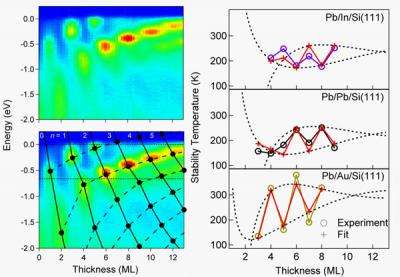
(left panel) Gray-scale plot of the photoemission intensity as a function of energy and film thickness for Pb films grown on the Au-6x6/Si(111) surface. The intensity maxima correspond to quantum well states whose energies are fit in accordance with the phase shift model. (right panel) Annealing temperature as a function of thickness at which Pb films grown on the metal-terminated surfaces become unstable. Fits to the results, including envelope functions, are also shown.
Just as every snowflake is different from any other, an individual snowball exhibits exceptionally different properties than the thousands of snowflakes that make it up. A group led by Dr. Tai-Chang Chiang of the University of Illinois studies how thin films of materials—such as lead films deposited on silicon—exhibit different traits than their more massive cousins. Most recently, they have found that it is possible to turn unstable films into stable ones.
"Our results demonstrate that unstable film thicknesses can be turned into stable ones. This capability is important for developing strategies for device applications," write Dr. Chiang and his colleagues in an article in Physical Review Letters (31 December 2005). The work was also summarized recently as a research highlight in the journal Nature (12 January 2006).
"In the present work, we compare the stability properties of Pb films deposited on Pb-, In-, and Au-terminated Si surfaces," explains Dr. Chiang. The research summarizes that while odd-numbered layers of thin films are normally less stable than even-numbered ones, when a coating of a layer of indium atoms is put between lead and silicon, the odd-numbered films become more stable.
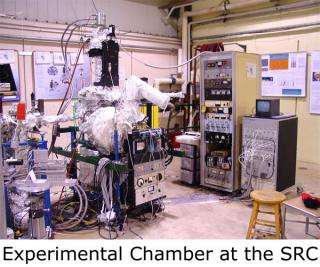
"In our research at SRC, we measure the electronic structure of films. Essentially all physical properties of materials are determined by their electronic structure. Due to quantum confinement and boundary effects, thin film electronic structure can be very different from the bulk counterpart, and likewise the properties can be substantially different and possibly useful," Chiang explains.
Indeed, it's this ability to reduce materials down to a few atoms of thickness—along with making the films as smooth as possible—that is the group's goal. "In some ways what we're trying to get is the simplest possible sample," explains Dr. Tom Miller, a member of the research team and a resident scientist at the Synchrotron Radiation Center at the University of Wisconsin, where the research was conducted. "So in a way we're trying to get the most boring sample possible!"
Yet for several years the group's progress has been anything but boring. In fact, Chiang and his colleagues have been exceptionally successful. While the work is deeply rooted in the fundamental exploration of physical properties, there are many exciting practical benefits to this research.
"Our work on atomically uniform films provides a fundamental understanding of the relationship between structure and properties based on quantum physics. Ultrathin films are important components for devices, now and future," says Chiang. "Our work on quantum well states began in the 1980's (at the Synchrotron Radiation Center). The first report of quantum well states as observed by angle-resolved photoemission appeared in 1986. My group discovered in 1998 that atomically uniform films of Ag can be prepared on Fe. In 2004, we reported that atomically uniform films of Pb and Ag can be prepared on Si and Ge; Si and Ge are the most important electronic substrate materials. The work has potential for great impact on future electronic devices."
Reference:
Ricci, D.A., Miller, T. and Chiang, T-C. Controlling the Thermal Stability of Thin Films by Interfacial Engineering. Phys. Rev. Letters 95, 266101 (2005).
Source: Synchrotron Radiation Center (by John Morgan)
-
From lemons to lemonade: Reaction uses carbon dioxide to make carbon-based semiconductor,
33 comments
-
Thioridazine kills cancer stem cells in human while avoiding toxic side-effects of conventional cancer treatments,
3 comments
-
SpaceX private rocket blasts off for space station (Update),
42 comments
-
Landmark calculation clears the way to answering how matter is formed,
55 comments
-
Research team claims to have found evidence Lake Cheko is impact crater for Tunguska Event,
18 comments
More news stories
Is a classical electrodynamics law incompatible with special relativity?
(Phys.org) -- The laws of classical electromagnetism that were developed in the 19th century are the same laws that scientists use today. They include Maxwell’s four equations along with the Lorentz la ...
Landmark calculation clears the way to answering how matter is formed
(Phys.org) -- An international collaboration of scientists, including Thomas Blum, associate professor of physics, is reporting in landmark detail the decay process of a subatomic particle called a kaon ...
May 25, 2012 |
4.3 / 5 (24) |
55
|
Lying in wait for WIMPs: Researchers seek to dramatically increase sensitivity of Large Underground Xenon detector
Although it's invisible, dark matter accounts for at least 80 percent of the matter in the universe. No one knows what it is, but most scientists would bet on weakly interacting massive particles, or WIMPs.
May 23, 2012 |
4 / 5 (7) |
19
|
Hawaii lab turns laser-powered bubbles into microrobots
(Phys.org) -- A team of scientists from the University of Hawaii are working on microrobots created from bubbles of air in a saline solution. The bubbles take on their title of robots as a laser ...
Sound increases the efficiency of boiling
Scientists at the Georgia Institute of Technology achieved a 17-percent increase in boiling efficiency by using an acoustic field to enhance heat transfer. The acoustic field does this by efficiently removing vapor bubbles ...
May 24, 2012 |
5 / 5 (2) |
2
Stunning image of smallest possible five-ringed structure
Scientists have created and imaged the smallest possible five-ringed structure about 100,000 times thinner than a human hair and you'll probably recognise its shape.
'Unzipped' carbon nanotubes could help energize fuel cells, batteries
Multi-walled carbon nanotubes riddled with defects and impurities on the outside could replace some of the expensive platinum catalysts used in fuel cells and metal-air batteries, according to scientists at ...
Change in developmental timing was crucial in the evolutionary shift from dinosaurs to birds: study
At first glance, it's hard to see how a common house sparrow and a Tyrannosaurus Rex might have anything in common. After all, one is a bird that weighs less than an ounce, and the other is a dinosaur that ...
Computer model used to pinpoint prime materials for efficient carbon capture
When power plants begin capturing their carbon emissions to reduce greenhouse gases and to most in the electric power industry, it's a question of when, not if it will be an expensive undertaking.
T cells 'hunt' parasites like animal predators seek prey, study shows
By pairing an intimate knowledge of immune-system function with a deep understanding of statistical physics, a cross-disciplinary team at the University of Pennsylvania has arrived at a surprising finding: T cells use a movement ...
Yale study concludes public apathy over climate change unrelated to science literacy
Are members of the public divided about climate change because they don't understand the science behind it? If Americans knew more basic science and were more proficient in technical reasoning, would public consensus match ...