Stardust placed into hibernation mode
Jan 31, 2006
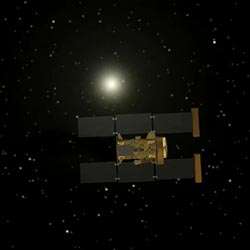
Artist concept of Stardust.

NASA's Stardust spacecraft was placed into hibernation mode yesterday. Stardust successfully returned to Earth samples of a comet via its sample return capsule on Jan. 15. The spacecraft has logged almost seven years of flight.

"We sang our spacecraft to sleep today with a melody of digital ones and zeros," said Tom Duxbury, Stardust project manager at NASA's Jet Propulsion Laboratory, Pasadena, Calif. "Stardust has performed flawlessly these last seven years and 2.88 billion miles and deserves a rest for a while, like the rest of the team."

The "song" was actually a series of commands that was sent up to the spacecraft yesterday, Jan. 29 at 4 p.m. Pacific time (7 p.m. Eastern time). The commands deactivated all but a few essential systems, such as Stardust's solar arrays and receive antenna - which will remain powered on. This long-term hibernation state could allow for almost indefinite (tens of years) out-of-contact operations while maintaining the spacecraft health.

"Placing Stardust in hibernation gives us options to possibly reuse it in the future," said Dr. Tom Morgan, Stardust Program Executive at NASA Headquarters, Washington. "The mission has already been a great success, but if at all possible we may want to add even more scientific dividends to this remarkable mission's record of achievement."

The Stardust spacecraft is currently in an orbit that travels from a little closer to the Sun than that of the Earth to well beyond the orbit of Mars. It will next fly past Earth on January 14, 2009, at a distance of about 1 million kilometers (621,300 miles).

NASA's Stardust sample return mission successfully concluded its prime mission on Jan. 15, 1006, when its sample return capsule carrying cometary and interstellar particles successfully touched down at 2:10 a.m. Pacific time (3:10 a.m. Mountain time) in the desert salt flats of the Utah Test and Training Range.

Stardust scientists at NASA's Johnson Space Center in Houston are currently analyzing what could be considered a treasure-trove of cometary and interstellar dust samples that exceeded their grandest expectations. Scientists believe these precious samples will help provide answers to fundamental questions about comets and the origins of the solar system.

Source: NASA

Explore further: The broken symphony of swinging metronomes

add to favorites email to friend print save as pdf

Related Stories

Prehistoric rock art maps cosmological belief

34 minutes ago

It is likely some of the most widespread and oldest art in the United States. Pieces of rock art dot the Appalachian Mountains, and research by University of Tennessee, Knoxville, anthropology professor Jan ...

Tech companies eye security that goes beyond passwords

46 minutes ago

In late February, a thief or thieves cracked into Evernote's digital vault filled with log-ins, passwords and email addresses belonging to 50 million users. It was a shocking cyberattack considering the Redwood City, Calif., ...

United Tech sees impact from order on fraud charge

1 hour ago

United Technologies Corp. says a federal court ordering it to pay $473 million plus interest to compensate for alleged fraud in its sale of fighter jet engines will cut revenue and profit.

States scramble to attract suddenly hot cybersecurity firms

1 hour ago

As data dragnets and information breaches dominate the news, states are scrambling to cash in on a rapidly expanding business sector by offering tax incentives to firms that protect sensitive information from outside attacks.

Recommended for you

China astronauts float water blob in kids' lecture

17 minutes ago

Astronauts struck floating martial arts poses, twirled gyroscopes and manipulated wobbling globes of water during a lecture Thursday from China's orbiting space station that's part of efforts to popularize ...

Looking at sachet water consumption in Ghana

10 hours ago

Many of West Africa's largest cities continue to lag in their provision of piped water to residents. Filling the service gap are plastic water sachets, which have become an important source of drinking water ...

User comments : 0

More news stories

China astronauts float water blob in kids' lecture

Astronauts struck floating martial arts poses, twirled gyroscopes and manipulated wobbling globes of water during a lecture Thursday from China's orbiting space station that's part of efforts to popularize ...

Metamorphosis of moon's water ice explained

Using data gathered by NASA's Lunar Reconnaissance Orbiter (LRO) mission, scientists believe they have solved a mystery from one of the solar system's coldest regions—a permanently shadowed crater on the ...

Danish chemists in molecular chip breakthrough

Electronic components built from single molecules using chemical synthesis could pave the way for smaller, faster and more green and sustainable electronic devices. Now for the first time, a transistor made ...

LA to give every student an iPad; $30M order

Los Angeles' school system, the second largest in the United States, is ordering iPads for all its students, handing Apple a major success in its quest to make the tablet computer a replacement for textbooks.