Researchers solve mystery of how DNA strands separate
Jul 03, 2007
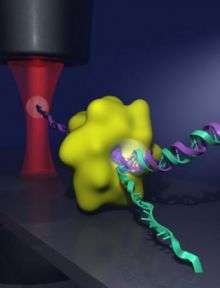
Graphic of DNA Strands Separating
This image shows a DNA double helix (green and purple strands) being separated by a helicase enzyme (green globule) at the junction where the two strands fork. To show that helicases actively separate the two strands of DNA, the researchers attached one end of a DNA strand to a microscope cover slip and attached the end of the other DNA strand to a micron-sized plastic bead. The bead was then trapped in a tightly focused laser beam (red), which allowed the researchers to measure the motion of the helicase as it unwound the DNA. Credit: Graphic created by Chris Pelkie and Daniel Ripoll/Cornell Theory Center

Cornell researchers have answered a fundamental question about how two strands of DNA, known as a double helix, separate to start a process called replication, in which genes copy themselves.

The research, published in the current issue of the journal Cell, examined the role of an enzyme called a helicase, which plays a major role in separating DNA strands so that replication of a single strand can occur.

Scientists have known that helicases bind to the area of a double helix where the two strands fork away from each other, like the free ends of two pieces of thread wound around each other. The forked area opens and closes very rapidly. But scientists have debated whether helicases actively separate the two strands at the fork or if they passively wait for the fork to widen on its own.

The research found that the helicase appears to actively exert a force onto the fork and separate the two strands.

"A simple passive unwinding mechanism does not explain our data," said Michelle Wang, associate professor of physics and the paper's senior author.

"Defects in helicases are associated with many human diseases, ranging from predisposition to cancer to premature aging," said co-author Smita Patel, a biochemistry professor at the Robert Wood Johnson Medical School in Piscataway, N.J. "Helicases are involved in practically all DNA and RNA metabolic processes."

The researchers made their discovery by anchoring one end of one of the strands in a double helix to the surface of a microscope cover slip. The end of the other strand was attached to a micron-sized plastic bead. They then focused a laser beam on the tiny bead and trapped the bead in place within the beam of light. This setup allowed the researchers to measure the position and force on the bead, creating a very precise sensor of the helicase motion. As the helicase moved toward the fork and the double helix unwound, the tension on the two strands lessened. Using statistical mechanics models, the researchers could then compare actual measurements of movement with predictions based on both active and passive scenarios.

"The unwinding has to have some active component to it, and based on our data, we can tell you exactly how active it is," said Wang. "Basically, it is an active unwinding motor."

While helicases unwind very rapidly in cells, in test tube experiments the unwinding is much slower. The researchers believe that helicases work with other enzymes, where "accessory proteins are helping the helicase out by destabilizing the fork junction," said Wang.

Source: Cornell University News Service

Explore further: Surprise species at risk from climate change

add to favorites email to friend print save as pdf

Related Stories

DNA gridlock: Cells undo glitches to prevent mutations

Jun 03, 2013

Roughly six feet of DNA are packed into every human cell, so it is not surprising that our genetic material occasionally folds into odd shapes such as hairpins, crosses and clover leafs. But these structures ...

Random walks on DNA

Apr 19, 2013

Scientists have revealed how a bacterial enzyme has evolved an energy-efficient method to move long distances along DNA. The findings, published in Science, present further insight into the coupling of chemical and mechan ...

Ancient enzymes function like nanopistons to unwind RNA

Sep 02, 2012

Molecular biologists at The University of Texas at Austin have solved one of the mysteries of how double-stranded RNA is remodeled inside cells in both their normal and disease states. The discovery may have implications ...

Study shows how DNA finds its match

Feb 08, 2012

It's been more than 50 years since James Watson and Francis Crick showed that DNA is a double helix of two strands that complement each other. But how does a short piece of DNA find its match, out of the millions ...

Recommended for you

Surprise species at risk from climate change

2 hours ago

(Phys.org) —Most species at greatest risk from climate change are not currently conservation priorities, according to an International Union for Conservation of Nature (IUCN) study that has introduced a ...

User comments : 0

More news stories

Surprise species at risk from climate change

(Phys.org) —Most species at greatest risk from climate change are not currently conservation priorities, according to an International Union for Conservation of Nature (IUCN) study that has introduced a ...

Origins of 'The Hoff' crab revealed (w/ Video)

The history of a new type of crab, nicknamed 'The Hoff' because of its hairy chest, which lives around hydrothermal vents deep beneath the Southern Ocean and Indian Ocean, has been revealed for the first ...

EUROnu project recommends building Neutrino Factory

(Phys.org) —The European Union's Seventh Framework Programme, EUROnu, has submitted its findings to a panel at CERN. Charged with choosing a project to study the nature of matter and antimatter, the project ...

'Ugly' finding: Unattractive workers suffer more

People who are considered unattractive are more likely to be belittled and bullied in the workplace, according to a first-of-its-kind study led by a Michigan State University business scholar.