LISA and the search for Einstein's waves
Scientists from across the world came together in London on 12-13 January to review the scientific and technical status of the LISA mission, the world’s first gravitational wave observatory, at a meeting organised by the Royal Astronomical Society (RAS) and the Institute of Physics.
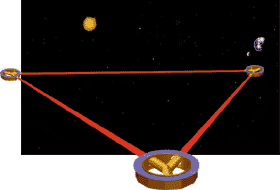
Scheduled for launch in 2016, LISA will be the largest scientific instrument ever constructed, consisting of three spacecraft, each separated by 5 million kilometres (3 million miles). Its task will be to detect the elusive gravitational waves which were predicted by Einstein’s Theory of General Relativity, published in 1916. To date, although astronomers have indirect evidence of their existence, none have yet been detected directly.
LISA will be one of the most challenging space science missions ever flown. In order to detect the passage of a gravitational wave, the distance between the spacecraft must be measured by laser beams to an accuracy of ten picometres, about one millionth of the diameter of a human hair!
Gravitational waves are emitted when very massive objects such as black holes spiral violently together or when neutron stars collide at high speed. These invisible waves squeeze and stretch spacetime as they travel to us from distant parts of the universe,
The waves travel from the source without absorption and this allows scientists to study objects at very great distances and the events that took place immediately after the birth of the Universe. Various models of the early universe predict gravitational wave emission during the first tiny fractions of a second, and if these can be detected by LISA scientists will learn a great deal about the processes active at that time.
The technology needed for gravitational wave detection in space is being developed in Europe and the US, with a major role being played by the UK. Groups at the Universities of Glasgow, Birmingham, Imperial College London and the Rutherford Appleton Laboratory have been working for over ten years to perfect the necessary instrumentation and a flight test of this hardware is planned for 2009 on a space mission called LISA Pathfinder.
Over a period of at least 2 years, LISA will detect gravitational waves from a variety of compact objects, ranging from massive black holes at great distances from the Earth to sub-solar mass white dwarfs – extremely dense, glowing remnants of dead stars - in our Galaxy.
The mission will consist of three spacecraft flying 5 million kilometres (3 million miles) apart in an equilateral triangle formation. Laser beams traveling between the spacecraft will be reflected from two test masses in each satellite. By obtaining extremely accurate measurements of the distance between the spacecraft, it will be possible to determine whether the fabric of spacetime in which they are traveling is being distorted by passing gravitational waves.
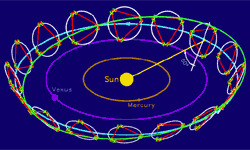
The formation of three spacecraft will face the Sun and lie in a plane that is tilted at 60 degrees to the Earth’s orbit. The trio will orbit the Sun, following 20 degrees behind the Earth, and will rotate once per year. This orbital motion will help to detect the direction of each source of gravitational radiation.
Although LISA will not be affected by vibrations that influence ground-based observatories, the test masses must be cocooned within active shields to protect them from the constant buffeting by charged particles pouring out of the Sun. Sensors will detect the relative motion of the spacecraft and the delicate test mass mirrors, and will command thrusters to minimise the relative motion.
Source: Royal Astronomical Society (RAS)


