The arXiv (pronounced "archive", as if the "X" were the Greek letter Chi, χ) is an archive for electronic preprints of scientific papers in the fields of mathematics, physics, astronomy, computer science, quantitative biology, statistics, and quantitative finance which can be accessed online. In many fields of mathematics and physics, almost all scientific papers are self-archived on the arXiv. On 3 October 2008, arXiv.org passed the half-million article milestone. The preprint archive turned 20 years old on 14 August 2011. By 2012 the submission rate has grown to more than 6000 per month.
Scientists work out way to use pulsars to provide self navigation to spacecraft in solar system
(Phys.org) —A trio of German space scientists has worked out a way to use pulsars as navigation aids for space vehicles traveling in the solar system. As they describe in their paper uploaded to the preprint ...
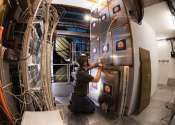
World's smallest droplet
(Phys.org) —Physicists may have created the smallest drops of liquid ever made in the lab. That possibility has been raised by the results of a recent experiment conducted by Vanderbilt physicist Julia Velkovska and her ...
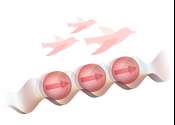
Manipulating Lorentz and Fano spectral line shapes
(Phys.org) —It is widely known that the optical properties of certain materials can be modified by using lasers to control the quantum states of their optical electrons. Lasers that can generate ultra-short ...
Los Alamos reveals it's been running quantum network for two and a half years
(Phys.org) —In a recent paper available on arXiv, a team of researchers at New Mexico's Los Alamos National Laboratory has revealed they've been running a quantum network for 2 1/2 years. The network is hub ...
Russian researcher claims to have found rocks from object that caused Tunguska explosion
(Phys.org) —Andrei Zlobin of the Russian Academy of Sciences' Vernadsky State Geological Museum, claims in a paper he's uploaded to the preprint server arXiv, that he's found rocks he believe to be fro ...
Materials scientist creates world's toughest fiber by adding slip knot
(Phys.org) —Italian materials scientist Nicola Pugno has realized amazing gains in adding toughness to fibers by twisting them into slip knots resulting in materials that can take far more abuse before ...
Researchers at IceCube detect record energy neutrinos
(Phys.org) —Researchers at the Antarctic research station IceCube are reporting that they've detected the highest ever energy neutrinos ever observed. In their paper they've uploaded to the preprint server ...
Researchers use Moore's Law to calculate that life began before Earth existed
(Phys.org) —Geneticists Richard Gordon of the Gulf Specimen Marine Laboratory in Florida and Alexei Sharov of the National Institute on Aging in Baltimore have proposed, in a paper uploaded to the preprint ...
Super-CDMS researchers report possible evidence of WIMPs
(Phys.org) —Researchers working at the Super Cryogenic Dark Matter Search (CDMS) facility, located underground in Minnesota's Soudan Mine, are reporting in a paper uploaded to the preprint server arXiv that t ...
Researchers devise a way to capture and release electromagnetic waves inside a metamaterial
(Phys.org) —A team of researchers at Kyoto University in Japan has discovered a way to capture and hold electromagnetic waves inside of a metalmaterial and then release them. As the group describes in their ...
Researchers measure Brazil nut effect in reduced gravity
(Phys.org) —A combined team of researchers from the Technical University of Braunschweig in Germany and Kobe University in Japan has determined that the Brazil nut effect is less pronounced as gravity is ...
Simulations indicate Milky Way may have up to 2000 black holes in its halo
(Phys.org) —Valery Rashkov and Piero Madau, space scientists with the University of California have uploaded a paper to the preprint server arXiv in which they suggest that the Milky Way galaxy likely has be ...
New clues to Wikipedia's shared super mind
(Phys.org) —Wikipedia's remarkable accuracy and usefulness comes from something larger than the sum of its written contributions, a new study by SFI Research Fellow Simon DeDeo finds.
Researchers capture possible first picture of 'Tatooine' type planet orbiting binary stars
(Phys.org) —An international team of space scientists led by Philippe Delorme of Joseph Fourier University in Grenoble, France has taken a photograph of what might be a very large planet orbiting two suns. ...
Researchers develop quantum computer algorithm for counting prime numbers
(Phys.org) —Two math and physics researchers from the University's of Barcelona and Madrid respectively have developed an algorithm to count prime numbers using a quantum computer. José Latorre and Germán ...