Page 4: Research news on thermal imaging

Thermal imaging is a non-contact sensing method that detects and visualizes spatial distributions of infrared radiation emitted by objects, converting them into temperature-resolved images. It typically employs uncooled microbolometer arrays or cooled photon detectors sensitive to mid- or long-wave infrared bands, with optics and calibration algorithms to map radiance to apparent surface temperature. The technique enables quantitative thermography, including emissivity correction, noise filtering, and temporal analysis, and is widely used for condition monitoring, biomedical diagnostics, materials characterization, building envelope assessment, and process control, where high sensitivity to small temperature gradients and accurate radiometric calibration are critical for reliable measurement and interpretation.

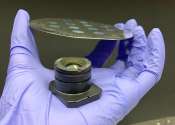
Silicon metasurfaces unlock broad-spectrum infrared imaging

Infrared imaging technology is crucial for advancing our understanding of the world, from exploring biological specimens to inspecting complex materials and detecting hidden patterns in physical systems.

Ultra-flat optics for broadband thermal imaging

Long-wavelength infrared (LWIR) imaging holds critical significance across many applications, from consumer electronics to defense and national security. It finds applications in night vision, remote sensing, and long-range ...

page 4 from 4