Page 20: Research news on Surface & interfacial phenomena

Surface and interfacial phenomena as a research area encompass the study of physical, chemical, and physicochemical processes occurring at phase boundaries, including solid–liquid, solid–gas, liquid–gas, and liquid–liquid interfaces. This field investigates adsorption, wetting, adhesion, capillarity, surface tension, interfacial rheology, and related equilibrium and non-equilibrium behaviors. It integrates thermodynamics, statistical mechanics, spectroscopy, microscopy, and simulation to elucidate structure–property relationships at interfaces. Research in this area underpins advances in catalysis, colloid and dispersion stability, electrochemistry, nanomaterials, biomembranes, microfluidics, and advanced coatings, with emphasis on how interfacial structure, composition, and energetics govern macroscopic material performance and functionality.

New method visualizes ligands on gold nanoparticles in liquid

The University of Antwerp and CIC biomaGUNE have come up with a promising method for understanding the role of surface molecules in the formation of nanoparticles. The groundbreaking research, published in Nature Chemistry, ...

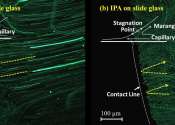
Observing flows at a liquid-liquid-solid intersection

Most of us are familiar with the classic example of a liquid-gas moving contact line on a solid surface: a raindrop, sheared by the wind, creeps along a glass windscreen. The contact line's movements depend on the interplay ...

Researchers use gold membrane to coax secrets out of surfaces

Using a special wafer-thin gold membrane, ETH researchers have made it significantly easier to study surfaces. The membrane makes it possible to measure properties of surfaces that are inaccessible to conventional methods.

Study reveals material erosion and deposition in fusion reactors

Researchers led by Prof. Luo Guangnan from the Hefei Institutes of Physical Science of the Chinese Academy of Sciences have made an important discovery about how materials break down and mix on the surfaces inside the experimental ...

Improving fingerprint detection with carbon-coated nanoparticles

Fingerprint detection is one of the most important techniques in forensic investigation. When fingerprints are dusted with a carbon-based powder, the material will adhere to the moisture and grease left behind by the unique ...

Atomic-resolution imaging shows why ice is so slippery

A team of physicists affiliated with several institutions in China has uncovered the reason behind the slipperiness of ice. In their study, published in the journal Nature, the group used atomic force microscopy to get a ...

Expanding on the fundamental principles of liquid movement

From the rain drops rolling down your window, to the fluid running through a COVID rapid test, we cannot go a day without observing the world of fluid dynamics. Naturally, how liquids traverse across, and through, surfaces ...

page 20 from 32