Page 7: Research news on Quarks

Quarks are elementary fermions that constitute a fundamental physical system underlying hadronic matter in the Standard Model of particle physics. They carry color charge and interact via the strong force, mediated by gluons, and also participate in electromagnetic and weak interactions according to their electric charges and weak isospin assignments. Quarks exist in six flavors (up, down, charm, strange, top, bottom) and are confined within composite systems such as baryons and mesons, never observed in isolation due to color confinement. Their dynamics are described by quantum chromodynamics (QCD), where quark fields and their color degrees of freedom form the fundamental components of strongly interacting systems.

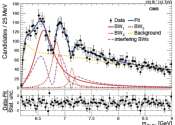
LHCb observes a new decay mode of the charmed beauty meson

The LHCb collaboration recently reported on the arXiv preprint server the first observation of the decay of the Bc+ meson (composed of two heavy quarks, b and c) into a J/ψ charm-anticharm quark bound state and a pair of ...

Study provides new insights into proton mass origins

A study led by Prof. Chen Xurong at the Institute of Modern Physics (IMP) of the Chinese Academy of Sciences (CAS) has provided new insights into the origins of proton mass. From an experimental standpoint, the researchers ...

Research reveals quantum entanglement among quarks

Collisions of high energy particles produce "jets" of quarks, anti-quarks, or gluons. Due to the phenomenon called confinement, scientists cannot directly detect quarks. Instead, the quarks from these collisions fragment ...

A dense quark liquid is distinct from a dense nucleon liquid

Atomic nuclei are made of nucleons (like protons and neutrons), which themselves are made of quarks. When crushed at high densities, nuclei dissolve into a liquid of nucleons and, at even higher densities, the nucleons themselves ...

Why string theory requires extra dimensions

String theory found its origins in an attempt to understand the nascent experiments revealing the strong nuclear force. Eventually another theory, one based on particles called quarks and force carriers called gluons, would ...

How do quark-gluon-plasma fireballs explode into hadrons?

Quark gluon plasma (QGP) is an exciting state of matter that scientists create in a laboratory by colliding two heavy nuclei. These collisions produce a QGP fireball. The fireball expands and cools following the laws of hydrodynamics, ...

page 7 from 7