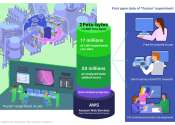
Plasma diagnostic techniques comprise experimental methods used to determine fundamental plasma parameters such as electron density and temperature, ion composition, electric and magnetic fields, and turbulence characteristics. They include invasive probes (e.g., Langmuir, emissive, and Mach probes), electromagnetic wave-based diagnostics (microwave interferometry, reflectometry), spectroscopic methods (optical emission, laser-induced fluorescence, Thomson scattering), and particle-based diagnostics (mass spectrometry, energy analyzers). These techniques rely on well-defined interaction mechanisms between fields, radiation, or particles and the plasma, and are critical for validating plasma theory, benchmarking numerical simulations, and controlling laboratory, fusion, space, and industrial plasma systems.