Page 19: Research news on Phase transitions

Phase transitions as a research area investigates qualitative changes in the macroscopic state of matter or systems as control parameters such as temperature, pressure, or external fields are varied, with emphasis on critical phenomena, universality, and order-parameter behavior. It encompasses equilibrium and nonequilibrium transitions, including first- and second-order transitions, symmetry breaking, renormalization-group theory, and scaling laws. The field spans condensed matter physics, statistical mechanics, and interdisciplinary complex systems, using analytical, numerical, and experimental methods to characterize phase diagrams, critical exponents, collective excitations, and emergent structures, and to understand how microscopic interactions give rise to distinct thermodynamic or dynamical phases.

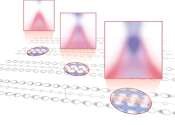
A look into the future of magnetic phase transitions

Researchers at PSI have observed for the first time how tiny magnets in a special layout align themselves solely as a result of temperature changes. This view into processes that take place within so-called artificial spin ...

Edgy light on graphene may bring new one-way information routers

Graphene has been the focus of intense research in both academic and industrial settings due to its unique electrical conduction properties. As the thinnest material known to man, graphene is essentially two-dimensional and ...

Skyrmion research: Braids of nanovortices discovered

A team of scientists from Germany, Sweden and China has discovered a new physical phenomenon: complex braided structures made of tiny magnetic vortices known as skyrmions. Skyrmions were first detected experimentally a little ...

Phase changing in graphite by interface charge injection

Graphite, as an important material for Li battery anode and graphene preparation, can exist in two phases: the Bernal (2H) phase and the rhombohedral (3R) phase. The 2H phase has relatively low energy and high proportion ...

Transforming a layered ferromagnet for future spintronics

A RMIT-led international collaboration published this week has achieved record-high electron doping in a layered ferromagnet, causing magnetic phase transition with significant promise for future electronics

page 19 from 19