Page 15: Research news on Particle accelerators

Particle accelerators are experimental techniques and associated infrastructures that use electromagnetic fields to accelerate charged particles, such as electrons, protons, or heavy ions, to high kinetic energies and control their trajectories for collision, beam-target, or irradiation experiments. They employ radiofrequency cavities, electrostatic fields, and magnetic optics (dipole, quadrupole, and higher-order magnets) to shape, focus, and steer beams with precise energy, emittance, and luminosity characteristics. As techniques, accelerators enable probing of fundamental interactions in high-energy physics, production of secondary particles (e.g., neutrons, mesons, synchrotron radiation), and finely controlled irradiation or imaging in materials science, nuclear physics, and medical and industrial applications.

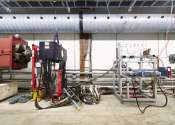
Hunting for millicharged particles at the LHC

The LHC family of experiments continues to grow. Alongside the four main experiments, a new generation of smaller experiments is contributing to the search for particles predicted by theories beyond the Standard Model, our ...

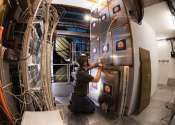
ALICE gets the green light for new subdetectors

Two detector upgrades of ALICE, the dedicated heavy-ion physics experiment at the Large Hadron Collider (LHC), have recently been approved for installation during the next long shutdown of the LHC, which will take place from ...

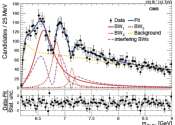
Large Hadron Collider experiment zeroes in on magnetic monopoles

The late physicist Joseph Polchinski once said the existence of magnetic monopoles is "one of the safest bets that one can make about physics not yet seen." In its quest for these particles, which have a magnetic charge and ...

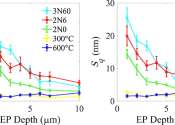
Smoother surfaces make for better accelerators

With every new particle accelerator built for research, scientists have an opportunity to push the limits of discovery. But this is only true if new particle accelerators deliver the desired performance—no small feat in a ...

page 15 from 17