Page 15: Research news on Particle accelerators

Particle accelerators are experimental techniques and associated infrastructures that use electromagnetic fields to accelerate charged particles, such as electrons, protons, or heavy ions, to high kinetic energies and control their trajectories for collision, beam-target, or irradiation experiments. They employ radiofrequency cavities, electrostatic fields, and magnetic optics (dipole, quadrupole, and higher-order magnets) to shape, focus, and steer beams with precise energy, emittance, and luminosity characteristics. As techniques, accelerators enable probing of fundamental interactions in high-energy physics, production of secondary particles (e.g., neutrons, mesons, synchrotron radiation), and finely controlled irradiation or imaging in materials science, nuclear physics, and medical and industrial applications.

First observation of photons-to-taus in proton–proton collisions

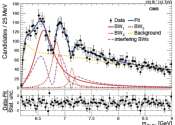
In March 2024, the CMS collaboration announced the observation of two photons creating two tau leptons in proton–proton collisions. It is the first time that this process has been seen in proton–proton collisions, which was ...

Preventing magnet meltdowns before they can start

The particle accelerators that enable high-energy physics and serve many fields of science, such as materials, medical, and fusion research, are driven by superconducting magnets that are, to put it simply, quite finicky.

Super strong magnetic fields leave imprint on nuclear matter

A new analysis by the STAR collaboration at the Relativistic Heavy Ion Collider (RHIC), a particle collider at the U.S. Department of Energy's (DOE) Brookhaven National Laboratory, provides the first direct evidence of the ...

Plan for Europe's huge new particle collider takes shape

Europe's CERN laboratory revealed more details Monday about its plans for a huge new particle accelerator that would dwarf the Large Hadron Collider (LHC), ramping up efforts to uncover the underlying secrets of the universe.

Latest search for new exotic particles at CERN

The CMS experiment has presented its first search for new physics using data from Run 3 of the Large Hadron Collider. The new study looks at the possibility of "dark photon" production in the decay of Higgs bosons in the ...

page 15 from 16