Page 9: Research news on Nuclear physics

Nuclear physics is a research area focused on the structure, dynamics, and interactions of atomic nuclei and their constituent nucleons, governed primarily by the strong and weak nuclear forces within the framework of quantum many-body and quantum field theories. It investigates phenomena such as nuclear binding, excitations, decay modes, and reactions, including fission, fusion, and nucleosynthesis. The field encompasses experimental and theoretical studies of stable and exotic nuclei, hadronic matter under extreme conditions, and the emergence of collective behavior from underlying nucleon–nucleon interactions, often employing accelerators, detectors, and advanced computational methods to probe fundamental properties of nuclear systems and refine effective interaction models.

Understanding the interior of atomic nuclei

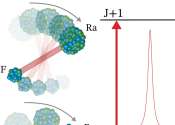
There is a lot going on inside atomic nuclei. Protons and neutrons are whizzing around and interacting with each other. The movement of the nuclear particles and their intrinsic angular momentum induce magnetic moments. Together, ...

Theory and experiment combine to shine a new light on proton spin

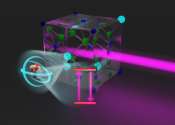
Nuclear physicists have long been working to reveal how the proton gets its spin. Now, a new method that combines experimental data with state-of-the-art calculations has revealed a more detailed picture of spin contributions ...

Super strong magnetic fields leave imprint on nuclear matter

A new analysis by the STAR collaboration at the Relativistic Heavy Ion Collider (RHIC), a particle collider at the U.S. Department of Energy's (DOE) Brookhaven National Laboratory, provides the first direct evidence of the ...

page 9 from 10