Page 8: Research news on Nuclear physics

Nuclear physics is a research area focused on the structure, dynamics, and interactions of atomic nuclei and their constituent nucleons, governed primarily by the strong and weak nuclear forces within the framework of quantum many-body and quantum field theories. It investigates phenomena such as nuclear binding, excitations, decay modes, and reactions, including fission, fusion, and nucleosynthesis. The field encompasses experimental and theoretical studies of stable and exotic nuclei, hadronic matter under extreme conditions, and the emergence of collective behavior from underlying nucleon–nucleon interactions, often employing accelerators, detectors, and advanced computational methods to probe fundamental properties of nuclear systems and refine effective interaction models.

'Mirror' nuclei help connect nuclear theory and neutron stars

Adding or removing neutrons from an atomic nucleus leads to changes in the size of the nucleus. This in turn causes tiny changes in the energy levels of the atom's electrons, known as isotope shifts. Scientists can use precision ...

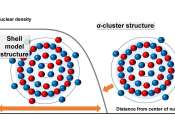
Physicists observe excited states in lanthanum-120

For the first time, physicists have observed excited states in the very neutron-deficient odd-odd nucleus, lanthanum-120. The study, published in Physics Letters B, was conducted by researchers from the Institute of Modern ...

Magnesium-18's unique decay process: From theory to practice

Led by physicist Si-Min Wang, the research team at Key Laboratory of Nuclear Physics and Ion-beam Application (MOE), Institute of Modern Physics, and Shanghai Research Center for Theoretical Nuclear Physics, NSFC, Fudan University, ...

page 8 from 10