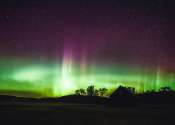
Page 6: Research news on geomagnetic storm

A geomagnetic storm is a large-scale disturbance of Earth’s magnetosphere caused by enhanced coupling between the solar wind and the geomagnetic field, typically following coronal mass ejections or high-speed solar wind streams from coronal holes. It is characterized by intensified magnetospheric convection, ring current enhancement, and reconfiguration of current systems such as the auroral electrojets. Storm development and recovery phases are quantified by indices like Dst and Kp, reflecting global magnetic field perturbations. Geomagnetic storms drive strong ionospheric currents, modify radiation belt populations, enhance auroral activity, and can induce geomagnetically induced currents in conductive technological infrastructures.

Blasts from the past: New insights from old space storms

On 4 August 1972, a burst of solar plasma rocked Earth's magnetic field after hurtling through space for about 14.6 hours—the fastest sun-to-Earth plasma journey ever recorded. The resulting space storm, one of several that ...

Solar storm could impact US hurricane recovery efforts: Agency

Severe geomagnetic storm conditions could hamper ongoing recovery efforts for Hurricanes Helene and Milton by disrupting satellite communications, power grids and GPS services, the US Space Weather Prediction Center warned ...

page 6 from 7