Page 2: Research news on geomagnetic storm

A geomagnetic storm is a large-scale disturbance of Earth’s magnetosphere caused by enhanced coupling between the solar wind and the geomagnetic field, typically following coronal mass ejections or high-speed solar wind streams from coronal holes. It is characterized by intensified magnetospheric convection, ring current enhancement, and reconfiguration of current systems such as the auroral electrojets. Storm development and recovery phases are quantified by indices like Dst and Kp, reflecting global magnetic field perturbations. Geomagnetic storms drive strong ionospheric currents, modify radiation belt populations, enhance auroral activity, and can induce geomagnetically induced currents in conductive technological infrastructures.

Risks of solar storms may be underestimated, warn researchers

The effects of extreme space weather may be larger than previously thought, research in the journal Nature reveals. The paper, titled "Regression to the mean can explain saturation of geomagnetic storms," is led by Dr. Nithin ...
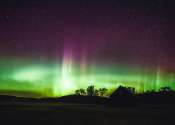
We can predict space weather—what if we could also stop it?

The weather on Earth can get pretty messy sometimes. But in space, it can be wild, and the effects can be far-reaching. Solar flares, giant explosions on the sun, can send out streams of energy that block radio communications ...

page 2 from 7