Research news on Dynamical systems

In the context of physical systems, dynamical systems are mathematical models that describe the time evolution of a system’s state, typically represented as points in a phase space governed by deterministic laws such as ordinary or partial differential equations, or discrete maps. Physical dynamical systems encode conservation laws, symmetries, and constraints arising from mechanics, electromagnetism, or other fundamental interactions. Their trajectories can exhibit fixed points, limit cycles, and chaotic attractors, with stability properties analyzed via linearization, Lyapunov exponents, and invariant manifolds. Dynamical systems theory provides a rigorous framework for predicting and characterizing the temporal behavior of physical systems across scales.

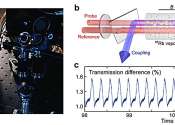
Physicists investigate dynamic phenomena of a time crystal

Physicists at TU Dortmund University have periodically driven a time crystal and discovered a remarkable variety of nonlinear dynamic phenomena, ranging from perfect synchronization to chaotic behavior within a single semiconductor ...

Engineers use machine learning to measure chaos in systems

How do we measure chaos and why would we want to? Together, Penn engineers Dani S. Bassett, J. Peter Skirkanich Professor in Bioengineering and in Electrical and Systems Engineering, and postdoctoral researcher Kieran Murphy ...

page 1 from 2