Page 9: Research news on Disordered systems

In physics, disordered systems are physical systems whose microscopic constituents (e.g., atoms, spins, impurities, or structural units) lack translational or orientational long-range order and are characterized by randomness in parameters such as positions, couplings, or local potentials. This quenched or annealed disorder crucially affects thermodynamic, transport, and dynamical properties, leading to phenomena such as Anderson localization, glassy dynamics, and complex energy landscapes. Disordered systems are modeled using probabilistic descriptions of disorder realizations and ensemble averages, often requiring techniques from statistical mechanics, random matrix theory, and renormalization group methods to analyze emergent macroscopic behavior and phase transitions in the presence of randomness.

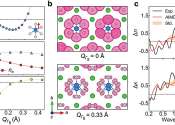
Solving the puzzle of 2D disorder

When players try to solve word games, they attempt to put together clues to find the solution. Sure, it helps to have a strong vocabulary, but finding the right answers to those puzzles is as much about logic and strategy ...

page 9 from 9