'Cry for help' gene identified in plants
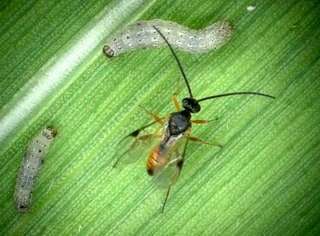
A genetic mechanism that enables corn plants to "cry for help" and attract beneficial insects has been clarified by scientists from the University of Neuchâtel, Switzerland and the Max Planck Institute for Chemical Ecology in Jena. Corn plants emit a cocktail of scents when they are attacked by certain pests, such as a caterpillar known as the Egyptian cotton leaf worm.
Parasitic wasps use these plant scents to localize the caterpillar and deposit their eggs on it, so that their offspring can feed on the caterpillar. Soon after, the caterpillar dies and the plant is relieved from its attacker. In the case of corn, only one gene, TPS10, has to be activated to attract the parasitic wasps. This gene carries information for a terpene synthase, an enzyme forming the sesquiterpene scent compounds that are released by the plant and attract wasps toward the damaged corn plant. Since this mechanism is based only on a single gene, it might be useful for the development of crop plants with a better resistance to pests (PNAS, Early Edition, January 16-20, 2006).
At least 15 species of plants are known to release scents after insect damage, thus attracting the enemies of their enemies. Scientists term this mechanism "indirect defence". A previous cooperation by the scientists in Neuchatel and Jena showed that indirect defence functions not only above ground, but also below the earth’s surface.
To understand the biochemistry behind this plant defence, biologists of the Max Planck institute studied corn plants, caterpillars of the species Spodoptera littoralis (Egyptian cotton leaf worm) and parasitic wasps of the species Cotesia marginiventris. Deciphering the complex mix of scents that the plants release after damage offered clues as to which classes of enzymes might be important for scent production.
The researchers isolated various genes encoding terpene synthases, the enzymes that produce these scents. One of these genes, TPS10, produced the exact bouquet of nine scent compounds that was released by the damaged corn plant. To demonstrate that TPS10 is indeed the important gene, the scientists introduced TPS10 into another plant, called Arabidopsis thaliana, which then released the same scents that have been observed in corn. To test whether these scents do attract the parasitic wasps, these plants were tested in an olfactometer, a device to study insect behaviour.
The researchers placed scent-producing as well as unmodified plants in the six arms of the olfactometer. When the predatory wasps were set free in the central cylinder of the olfactometer, they flew towards the scent-producing plants. The experiments led to an additional, surprising result: in order to react this way, the wasps needed a first exposure to both the corn scent and the caterpillar which led them to associate the two. Young, "naive" wasps without this experience could not distinguish between scent-producing plants and control plants, or failed to move at all.
Source: Max Planck Institute


